







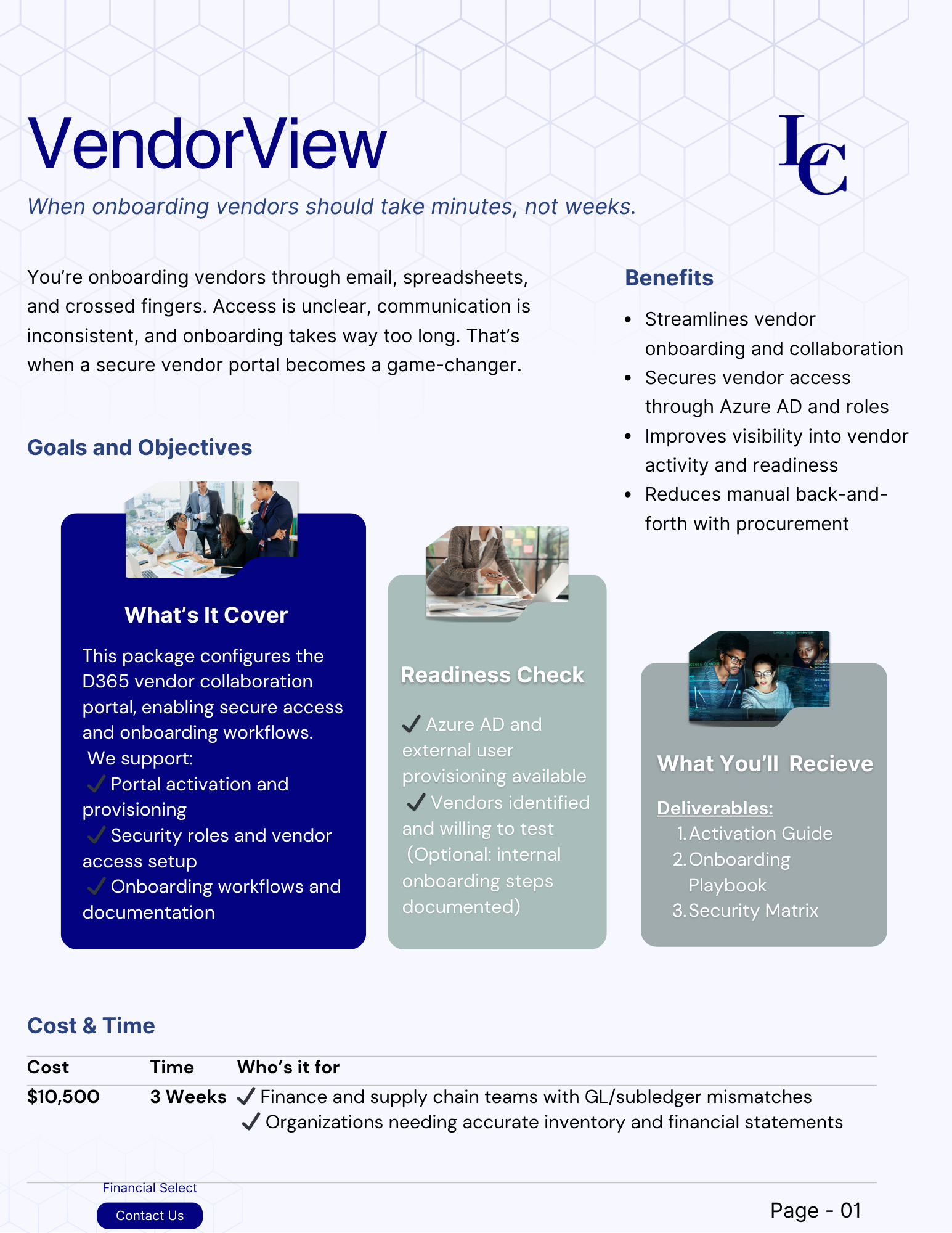


Reviews and corrects ledger-to-subledger alignment in D365 by fixing posting configurations, inventory profiles, reconciliation logic, GL mapping, and critical reporting procedures.
Project Management in Construction and Across Other Verticals: How Acumatica Keeps Projects Profitable
Posted on: August 4, 2026 | By: Jackson Morris | Acumatica
Managing projects is one of the hardest things a business can do well. Budgets shift, change orders pile up, labor costs fluctuate, and the data needed to make decisions is often scattered across spreadsheets, point solutions, and accounting systems that do not talk to each other. While construction feels this pain most strongly, the same problems affect any project-driven business, from engineering firms to manufacturers producing custom orders. Acumatica addresses this challenge by embedding project management and project accounting directly into the ERP, giving organizations one system for planning, executing, and billing every project.

What Project Management Looks Like Inside Acumatica
Acumatica treats projects as first-class citizens within the ERP rather than as an add-on module. Every project carries its own budget, tasks, cost codes, revenue structure, and billing rules, all connected directly to the general ledger, accounts payable, accounts receivable, inventory, and payroll. When a field employee logs time, purchases materials, or submits an expense, that transaction flows to the project in real time.
This connection matters because most project overruns are discovered too late. When project data lives in a standalone tool and financials live in the accounting system, someone has to reconcile the two, and by the time they do, the margin is already gone. With Acumatica, project managers and finance leaders see cost-to-complete, committed costs, and budget variance as they happen, not at month end.
Purpose-Built for Construction
Construction is where Acumatica’s project capabilities run deepest. Acumatica Construction Edition connects contracts, budgets, change orders, subcontracts, retainage, and compliance documentation in a single system. Job costing captures labor, material, and equipment costs with instant updates, so project accounting and field operations stay in sync throughout the life of a job.
Change management is a particular strength. Change orders link directly to the project budget and billing schedule, so an approved change updates the financial picture immediately instead of surfacing weeks later as an unpleasant surprise. Acumatica has also continued to invest in this edition; the 2024 R2 release to help contractors manage the full project lifecycle from quote to closeout.
Mobile access rounds out the construction story. Superintendents and project managers can review budgets, capture daily field reports, approve invoices, and manage change orders from the job site, keeping the office and the field working from the same information.
Project Management Beyond Construction
While construction gets the headlines, project-driven work exists across the midmarket. Engineering and architecture firms bill by phase and milestone. IT consultancies track billable hours against fixed-fee engagements. Manufacturers running engineer-to-order or make-to-order operations need to know whether each custom job is profitable. Field service organizations manage installations that behave like small projects.
Acumatica supports all of these through its project accounting foundation, and the company has expanded its industry focus with the Professional Services Edition, built for firms whose product is their people. The Acumatica 2025 R2 release with web-based project labor tracking that ties directly into payroll and billing, mobile change order management, and comprehensive work-in-progress reporting for real-time project performance insights. For services firms, that means fewer unbilled hours, faster invoicing, and a clear view of which engagements actually make money.
Business Value for Finance and Operations Leaders
For CFOs and controllers, integrated project management changes the quality of financial information. Revenue recognition, WIP reporting, and percentage-of-completion accounting draw from live project data rather than manual reconciliations. Billing accelerates because time, expenses, and milestones are already in the system when the invoice is generated.
For operations leaders, the value is control. Resource allocation, task scheduling, and budget tracking sit in the same platform as procurement and inventory, so decisions account for the full operational picture. Dashboards can be tailored by role, giving executives portfolio-level visibility while project managers drill into individual jobs.
Best Practices for Getting the Most from Acumatica Projects
Organizations that succeed with project accounting tend to follow a few consistent practices. Standardize project templates for your common project types so budgets, tasks, and billing rules are set up consistently every time. Define cost codes thoughtfully at the start, since they determine how granular your reporting can be later. Train both finance and operations teams on the project workflows, because the value of an integrated system depends on everyone using it. Finally, review budget variance and cost-to-complete on a regular cadence, weekly rather than monthly, so problems are caught while they are still small.
Next Steps
Whether you are a contractor managing complex jobs, a services firm tracking billable engagements, or a manufacturer costing custom orders, disconnected project data puts margins at risk. Logan Consulting helps project-driven organizations implement and optimize Acumatica so project management, accounting, and operations work as one system. If you want to improve project visibility and profitability, contact Logan Consulting to see how Acumatica can support your projects.