

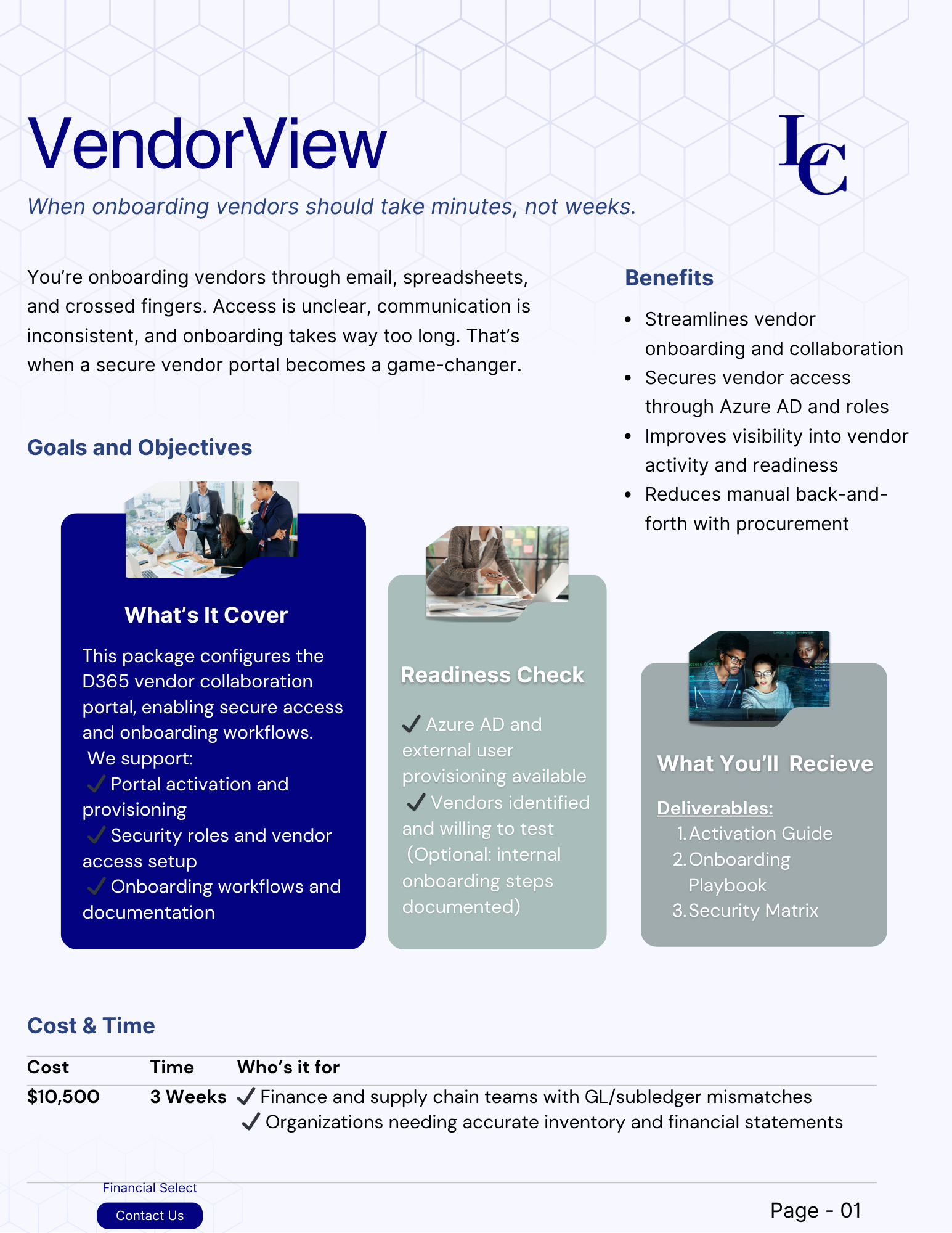


Reviews and corrects ledger-to-subledger alignment in D365 by fixing posting configurations, inventory profiles, reconciliation logic, GL mapping, and critical reporting procedures.
Category: ERP Selection
Managing Deductions: How Deductions Can Be Set Up to Fit Business Needs in QAD AUX
Posted on: April 13, 2026 | By: Blake Moore | QAD Manufacturing, ERP Selection|QAD Business Process, QAD Financials|QAD Business Process, ERP Selection
In today’s complex customer and supplier environments, deductions are inevitable. Whether tied to promotions, freight disputes, quality issues, or pricing discrepancies, businesses need a structured way to manage them without disrupting cash flow or creating reconciliation chaos. That’s where QAD AUX provides flexibility — allowing organizations to configure deduction management in a way that mirrors their real-world processes rather than forcing teams into rigid workflows. Why Deduction Management Matters In...
Preparing for Microsoft Dynamics GP End of Life? Logan’s ERP Showdown Can Help
Posted on: April 10, 2026 | By: Anika Dewjee | Microsoft Dynamics GP, ERP Selection
For decades, Microsoft Dynamics GP has been a reliable ERP solution for many organizations. However, as Microsoft continues to prioritize cloud-based platforms, businesses running GP must begin preparing for the future. While GP will not disappear immediately, the reality is clear: innovation and long-term investment are shifting toward modern cloud ERP solutions. For organizations still on GP, the question is no longer if they should move, but when and how. Why Planning Early Matters Waiting...
Closing the Execution Gap: How QAD Aligns Planning with Reality
Posted on: April 8, 2026 | By: Blake Moore | QAD Financials, ERP Selection, QAD Manufacturing, QAD Distribution, ERP Selection|QAD Business Process, QAD Financials|QAD Business Process
In manufacturing, the plan always looks clean on paper. Demand forecasts align neatly with capacity. Lead times behave as expected. Inventory levels stay within target. Then reality intervenes. A supplier misses a shipment. A machine goes down. A customer changes an order. Production falls behind. The gap between what was planned and what actually happens is the execution gap, and it is one of the biggest operational challenges manufacturers face....
Choosing Your Next ERP? Join Logan Consulting’s Middle Market ERP Showdown
Posted on: April 6, 2026 | By: Anika Dewjee | ERP Selection
Selecting the right ERP system is one of the most important decisions a growing organization can make. With so many options available, it can be difficult to cut through the noise and understand which platform truly aligns with your business needs. That’s why Logan Consulting is hosting a live event designed to help you make a more informed decision. A Side-by-Side ERP Comparison Join us for an in-depth, side-by-side comparison of three leading ERP solutions: Microsoft Dynamics 365...
ERP Isn’t a Software
Posted on: January 21, 2026 | By: Blake Moore | ERP Selection, ERP Selection|QAD Business Process
Too often, ERP projects start with the wrong assumption: that ERP is a piece of software you buy, install, and then magically benefit from. It isn’t. ERP is a foundational framework for how an organization operates, makes decisions, and aligns people, processes, and data toward a common goal. The software is simply the tool that supports that concept. Treat it as anything less, and the project is already at risk....
The Future of EDI Integrations with QAD O3: A Seamless, Intelligent Supply Chain
Posted on: June 2, 2025 | By: Alexa Leitner | ERP Selection, QAD Business Process, EDI
In an increasingly digital world, Electronic Data Interchange (EDI) remains the backbone of B2B communication, especially in manufacturing, supply chain, and logistics. With the emergence of QAD O3, the next-generation cloud ERP from QAD Inc., the future of EDI integrations is undergoing a significant transformation. QAD O3 not only streamlines core ERP functionalities, but also opens new possibilities for smarter, faster, and more scalable EDI implementations. EDI’s Enduring Value in...
ERP System Upgrades: Why Accurate Subledger Migration Matters
Posted on: August 28, 2025 | By: Alexa Leitner | ERP Selection, QAD Business Process
Upgrading an ERP (Enterprise Resource Planning) system is a strategic move for organizations aiming to modernize operations, improve data integrity, and support evolving business requirements. These upgrades typically involve transitioning to more advanced platforms, integrating new capabilities, and optimizing workflows. However, one of the most critical, and often underrated, success factors is the accurate migration of financial data, especially subledger balances. Subledgers such as Accounts Payable, Accounts Receivable, and Fixed...
The Hidden Costs of Poor ERP Utilization
Posted on: August 20, 2025 | By: Alexa Leitner | ERP Selection, QAD Business Process
For most organizations, the ERP system represents one of the largest technology investments ever made. It is designed to integrate processes, provide visibility, and serve as the backbone for financial, operational, and compliance activities. Yet, in many cases, ERP systems remain underutilized or poorly integrated with other business-critical systems. The real danger is that the costs of poor ERP usage are often invisible. They don’t appear as a single line...
Why Tying ERP System Adoption to Individual Success Drives Long-Term Growth
Posted on: July 17, 2025 | By: Alexa Leitner | ERP Selection, QAD Business Process
Our experience is that one of the most underestimated and over overlooked challenges in ERP adoption is the human fear that comes with letting go of control. For many users, spreadsheets aren’t just tools—they’re security blankets. They represent familiarity, autonomy, and, in many cases, a quiet form of job protection. It isn’t the first concern users will acknowledge, but after probing about the reluctance to give up their spreadsheets, we often hear...
Moving from Off-Line Systems to ERP: Helping Teams Embrace Change and Scale Smarter
Posted on: June 11, 2025 | By: Alexa Leitner | ERP Selection, QAD Business Process
As we continue to work with companies who grow and are required to accomplish more with fewer resources, they inevitably run into the limits of the systems that got them started—especially when those systems are spreadsheets, whiteboards, paper logs, or homegrown Access tools. These tools often work well in the early days. They're flexible, fast, and built by people who know the business inside and out. But as their business...