



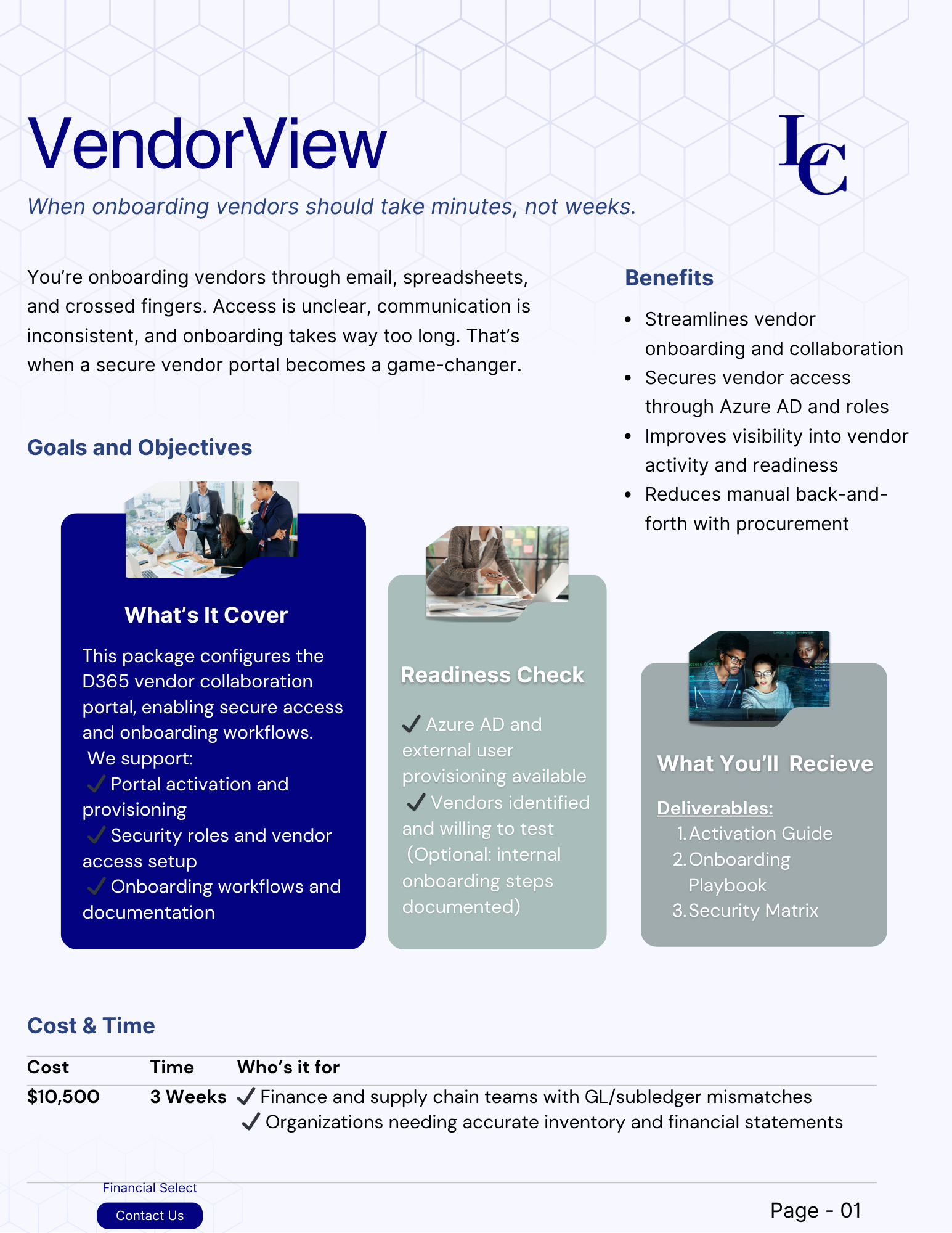


Reviews and corrects ledger-to-subledger alignment in D365 by fixing posting configurations, inventory profiles, reconciliation logic, GL mapping, and critical reporting procedures.
MANUFACTURING IN 2030 STARTS TODAY
Posted on: July 21, 2026 | By: Kyle Valerio | Microsoft Dynamics AX/365, Microsoft Dynamics Manufacturing, Microsoft Dynamics AX/365|Microsoft Dynamics Manufacturing
Is Your Dynamics 365 Environment Ready?
The next manufacturing advantage will not come from owning more AI. It will come from turning trusted operating signals into faster, governed decisions.
Manufacturing is not waiting for 2030.
The machines are already producing more data. Planners are already being asked to explain demand shifts faster. Customers are already treating confirmed delivery dates like commitments rather than suggestions. And AI is already moving from presentation slides into procurement, planning, quality, and factory operations.[1,4]
The uncomfortable truth is that the manufacturers best positioned for 2030 will not necessarily be the ones with the newest robots, the largest data lake, or the most Copilot licenses. They will be the ones whose systems can turn a trustworthy operating signal into a governed decision before the problem becomes expensive.
| LOGAN POV Manufacturing 2030 is not an AI project. It is an operational-readiness project with AI on top. |
The ERP Is Becoming an Operational Control Plane
Historically, ERP answered a backward-looking question: What happened? The next generation of manufacturing operations has to answer three questions in sequence: What is happening, what does it affect, and what should we do next?
That does not mean Dynamics 365 should absorb every sensor reading or replace a plant’s manufacturing execution system. It means D365 should own the business context around those signals: the production order, material consumption, available inventory, customer promise, cost impact, and financial consequence.
Microsoft’s current Supply Chain Management capabilities point in that direction. Third-party MES integration can synchronize production starts, finished and scrapped quantities, material consumption, time, and order completion back to D365. Sensor Data Intelligence can now auto-report production progress from electronic sensors, giving the production floor execution interface a more current view of completed units. Microsoft Fabric’s connected-factory reference architecture shows how real-time industrial data can be contextualized across equipment, shifts, inventory, and cost at very large scale.[5,6,7]
If the ERP learns that production finished only after a supervisor updates a spreadsheet at 4:30, that is not real-time visibility. It is a diary.
Figure 1. The emerging role of D365: a control plane connecting planning, execution, finance, and customer commitments.
AI Will Move from Assistant to Operating Leverage
The first wave of generative AI helped people summarize meetings, draft messages, and find information. Useful? Absolutely. Transformational? Not by itself.
The more important shift is operational AI: intelligence that is grounded in manufacturing context and embedded inside a decision window. Microsoft’s manufacturing data solutions in Fabric are designed to unify data from MES platforms, machines, sensors, PLCs, and business applications in a shared manufacturing model. Factory Operations Agent then allows users to query that context in natural language rather than learning another technical query language.[8]
Inside D365, the same pattern is appearing across planning and procurement. Demand planning can incorporate multiple signals such as historical sales, pricing, inflation, and weather; generative insights can identify trends, seasonality, and correlations. The Procurement Agent can analyze supplier changes and trace downstream effects on inventory, production orders, transfers, and customer deliveries. Planning Optimization is also moving toward protecting material and capacity already committed through capable-to-promise dates.[9,10,11]
That is the right role for AI in manufacturing. Not replacing experienced planners, buyers, or plant leaders. Compressing the time between signal, context, and action.
AI with bad master data is not intelligent manufacturing. It is a confident intern with admin rights.
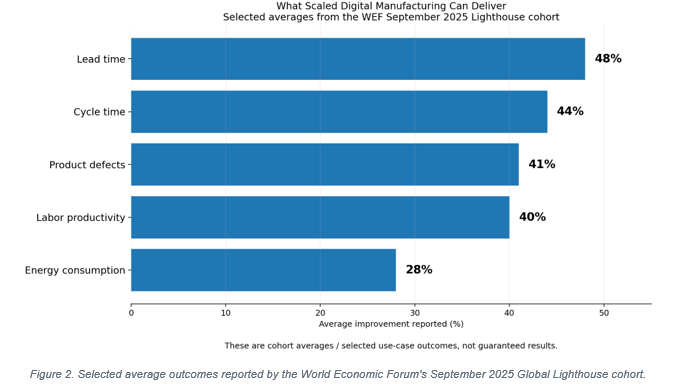
The World Economic Forum’s Lighthouse network offers an important reality check: digital manufacturing produces value when technologies are scaled across operating systems, not left as disconnected pilots. Its 2025 cohort reported strong average improvements in productivity, lead time, defects, energy use, and cycle time, while the 2026 cohort emphasized resilience, AI embedded in core operations, and transformation across networks rather than individual sites.[1,2]
The Labor Gap Makes Automation Economic, Not Optional
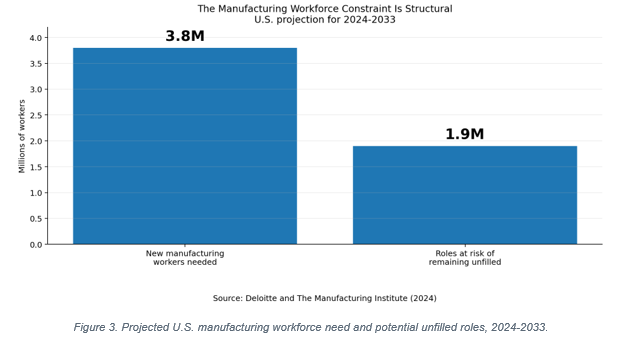
Manufacturing’s labor challenge is not a temporary scheduling inconvenience. Deloitte and The Manufacturing Institute estimate that U.S. manufacturing could require as many as 3.8 million new workers between 2024 and 2033, with roughly 1.9 million roles at risk of going unfilled if the talent gap persists.[3]
That changes the economics of automation. The goal is not a people-free factory. It is a factory where scarce people spend less time rekeying completions, chasing purchase-order confirmations, correcting inventory, or explaining why the system and the floor disagree.
Automated production reporting, warehouse scanning, governed workflows, sensor-driven quality triggers, and exception-based planning all create leverage. They also improve the work itself. The most valuable automation often removes the part of a job nobody would miss.
Data Quality Is the Competitive Advantage Nobody Photographs
The source draft gets this exactly right: duplicate vendors, inconsistent item masters, outdated bills of material, poor inventory accuracy, and spreadsheets outside the ERP do more than create administrative friction. They limit every advanced capability that comes next.
A planning model cannot reliably forecast an item whose lead time changes by site without governance. A procurement agent cannot assess downstream impact if pegging, dates, and order relationships are incomplete. A connected-factory model cannot explain machine performance if asset identities differ across MES, maintenance, IoT, and finance.
A useful readiness review should test more than whether fields are populated. It should measure whether the data is operationally believable:
- Inventory accuracy by site and tracking dimension
- Percentage of active items with current BOM/formula and route versions
- Production transactions posted within the required decision window
- Vendor, customer, and location duplicates or inactive records still in use
- Integration failures, retries, and unowned exception queues
- Manual inventory and financial adjustments by root cause
If item 123 has three names, four lead times, and a BOM last reviewed during a different presidential administration, Copilot is not the first problem.
Predictive Supply Chains Need Protected Commitments, Not More Alerts
Most manufacturers already have alerts. What they lack is a disciplined chain from detection to decision.
Consider a supplier pushing a material delivery back five days. The useful question is not merely whether the purchase order changed. The useful question is whether that change delays a production order, consumes safety stock, moves a customer delivery, alters revenue timing, or creates an expedite decision.
That is why features such as Procurement Agent impact analysis, multi-signal demand planning, and CTP date protection matter. They move the conversation from visibility to consequence. A mature supply chain does not simply see disruption earlier; it knows which commitment to protect and which tradeoff to make.[9,10,11]
Connected Manufacturing Without Architecture Becomes Integration Sprawl
Manufacturing data will continue to live across ERP, MES, warehouse systems, quality applications, maintenance platforms, industrial controls, IoT services, Fabric, and Power Platform. The goal is not to force every system into one application. The goal is to define a clean contract between them.
For each major data domain, IT and operations should agree on four things:
- Which system owns the record
- Which event communicates the change
- How the receiving system confirms or rejects it
- Who owns the exception when the integration fails
This is where many ‘connected factory’ programs quietly become a forest of point-to-point integrations. Everything is connected, technically. Nobody is quite sure which number wins.
Microsoft’s MES integration guidance includes business events, APIs, and centralized message monitoring for exactly this reason: integration is an operating process, not a one-time interface build.[6]
Cyber Resilience Is Production Resilience
A more connected plant is also a larger attack surface. IBM’s 2026 X-Force reporting says manufacturing remained the most targeted industry for the fifth consecutive year and accounted for 27.7% of observed incidents in 2025.[12]
That means identity, integration security, patching, segmentation, monitoring, and recovery procedures belong inside the manufacturing-transformation roadmap. If you connect the plant to the cloud but leave IT, OT, and security governance disconnected, you have created a faster way to stop production.
A Practical 12-Month Readiness Agenda
Preparing for 2030 does not require a five-year moonshot. It requires a year of disciplined sequencing.
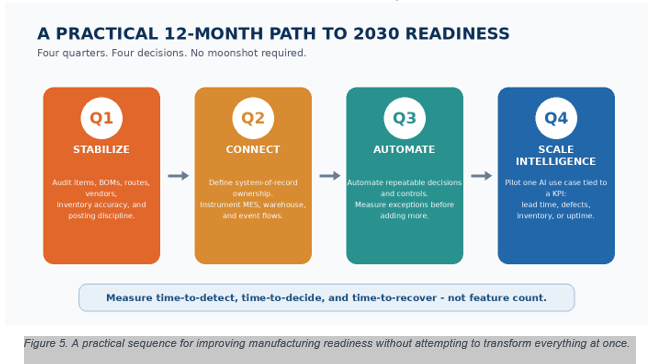
Choose one operational decision that is currently slow, manual, or unreliable. Establish the baseline. Improve the underlying process and data. Connect the required systems. Automate the repeatable part. Only then apply AI to the remaining decision friction.
Final Thought
Manufacturing in 2030 will not be defined by who bought the newest ERP, installed the most sensors, or announced the largest AI initiative.
It will be defined by who can sense a meaningful change, understand its business consequence, make a governed decision, and execute that decision before the window closes.
Dynamics 365 already provides much of the foundation: planning, procurement, production, warehouse execution, finance, integration patterns, workflow, and a growing layer of AI-assisted decision support. The opportunity is not to replace the platform. It is to make the platform reflect how the business actually needs to operate.
The future of manufacturing is not hiding in 2030. It is hiding in the processes, data problems, and delayed decisions the organization is tolerating today.
Research Note
| Microsoft release plans describe capabilities that may still change before delivery. Dates and availability should be validated in the Release Planner and the target D365 environment before making deployment commitments. |