






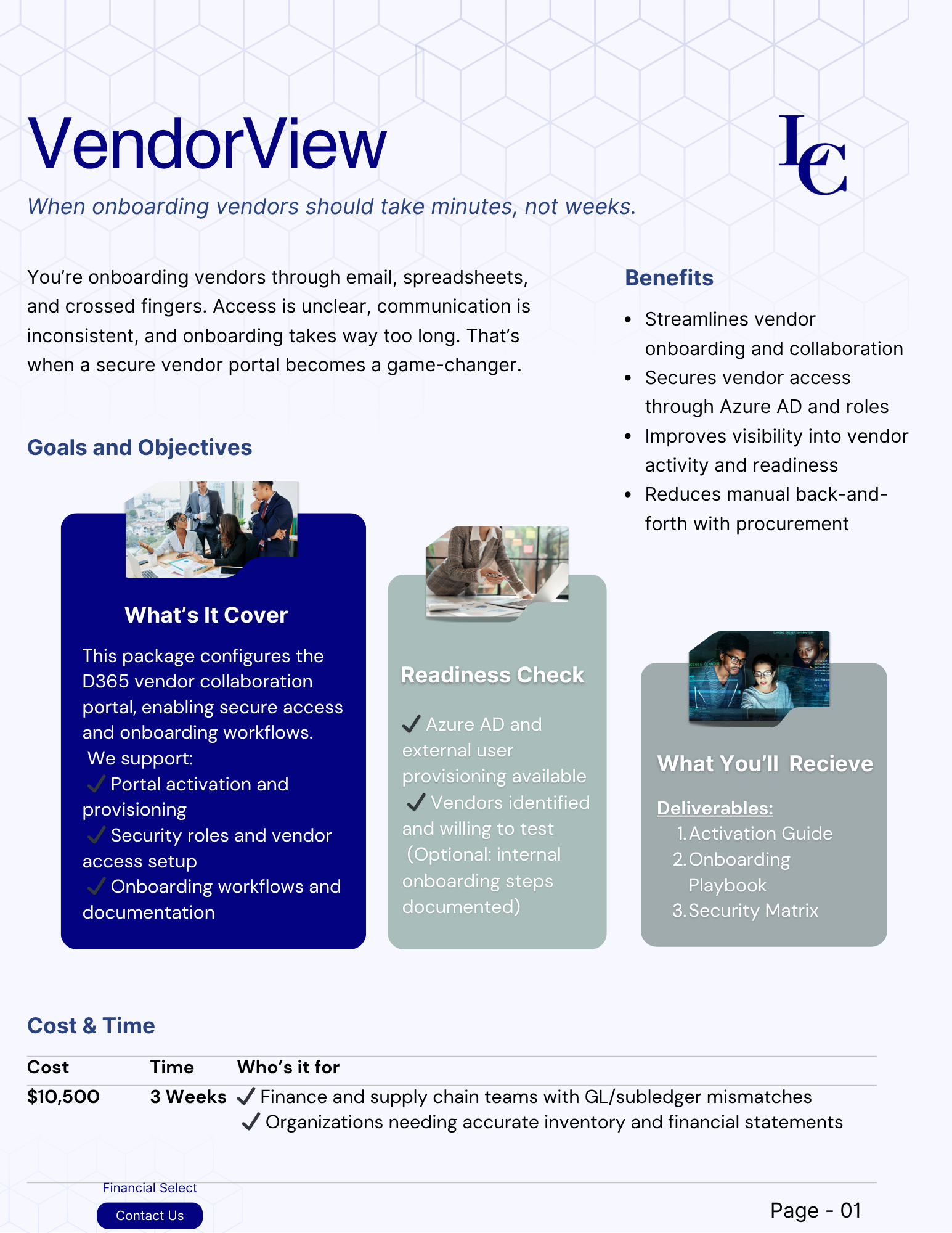


Reviews and corrects ledger-to-subledger alignment in D365 by fixing posting configurations, inventory profiles, reconciliation logic, GL mapping, and critical reporting procedures.
How Family Offices Are Using NetSuite to Manage Complex Wealth Structures
Posted on: July 16, 2026 | By: Jackson Morris | NetSuite
Family offices exist to protect and grow wealth across generations, but many are still running that mission on spreadsheets, disconnected accounting files, and manual reconciliation between operating businesses and investment entities. As families accumulate more holding companies, investment vehicles, real estate partnerships, and trusts, the finance team’s job gets harder every year. Consolidating results across a dozen or more legal entities by month end, while also giving family principals a clear, real-time picture of performance, becomes nearly impossible without the right systems in place.
This is the operational reality behind a growing trend: family offices adopting cloud ERP platforms like Oracle NetSuite to bring structure, visibility, and control to increasingly complex financial ecosystems.

Why Family Office Finance Is Different
A typical midmarket company manages one or two legal entities. A family office often manages dozens: operating businesses, holding companies, special purpose investment vehicles, real estate LLCs, and charitable entities, each with its own ownership structure, currency, and reporting requirements. Layered on top of that is the family’s need for both detailed operational reporting and simplified, high-level summaries for principals and board members who may not want to see line-item detail.
Industry research on the sector reflects just how common this complexity has become. Recent data from J.P. Morgan’s Global Family Office Report found that roughly six in ten family offices also run an operating company alongside their investment activities, adding an entirely separate layer of accounting, payroll, and compliance work on top of wealth management. At the same time, the family office market itself continues to expand, with research firms projecting steady growth in the number of offices being established as wealth becomes more concentrated and more complex to manage.
Generic accounting tools, or a patchwork of QuickBooks files and spreadsheets, simply were not built for this level of structural complexity. That gap is why more family offices are evaluating purpose-built ERP platforms.
Key Benefits of NetSuite for Family Offices
NetSuite’s multi-subsidiary and multi-entity architecture is one of the primary reasons family offices consider the platform. A single instance can consolidate financials across many entities, currencies, and ownership percentages, automatically eliminating intercompany transactions and producing consolidated statements without the manual spreadsheet work most offices rely on today.
Role-based dashboards are equally important. A controller or CFO can work in detailed, transaction-level views, while principals and family board members see simplified summaries built around the metrics that matter to them, such as net worth by entity, cash position, or investment performance. This flexibility allows one system to serve very different audiences within the same family structure.
NetSuite also supports the operational side of family offices that run businesses alongside their investment portfolios. Payroll, procurement, inventory, and project accounting can sit in the same platform as investment and holding company accounting, giving the finance team one system of record instead of several disconnected ones.
Real-World Applications
For family offices with direct investments in private equity, venture capital, or real estate, tracking the full lifecycle of an investment matters as much as tracking day-to-day operations. That includes capital calls, distributions, valuations, and eventual exits. NetSuite’s investment management capabilities are designed to give family offices and similar investors a single view of profitability across the entire life of an investment, from initial sourcing through liquidation, rather than reconstructing that history from separate spreadsheets each quarter.
Multi-generational reporting is another common use case. As younger family members become more involved in governance, family offices need reporting that can be tailored to different levels of financial literacy and different levels of access. NetSuite’s permission structures allow finance teams to control exactly what each family member or advisor can see, while still maintaining one accurate source of financial truth behind the scenes.
Preparing for the Future
Regulatory scrutiny of private investment vehicles has increased in recent years, with regulators asking for more transparency into how private funds and family offices report performance and manage investor relationships. That trend puts pressure on family offices to move away from manual processes and toward systems that can produce accurate, auditable records on demand.
At the same time, family offices are beginning to explore AI-enabled forecasting and reporting tools to help principals make faster, better-informed decisions about asset allocation and risk. A modern ERP platform is often the foundation that makes those capabilities possible, since AI tools are only as useful as the data feeding them. Family offices that consolidate their financial data into a single, well-structured system today will be far better positioned to take advantage of these tools as they mature.
Succession planning adds one more dimension. As wealth and operating responsibility transfer to the next generation, having clean, well-organized financial systems makes that transition far smoother than trying to untangle years of disconnected spreadsheets and side systems.
Next Steps
Family offices face a unique combination of operational and investment complexity, and generic accounting tools rarely keep up. Logan Consulting helps family offices and multi-entity organizations evaluate, configure, and implement NetSuite to bring consolidated reporting, investment tracking, and multi-generational visibility into a single, reliable system.
If your family office is outgrowing spreadsheets or disconnected systems, contact Logan Consulting today to discuss how NetSuite can support your organization’s long-term financial strategy.