

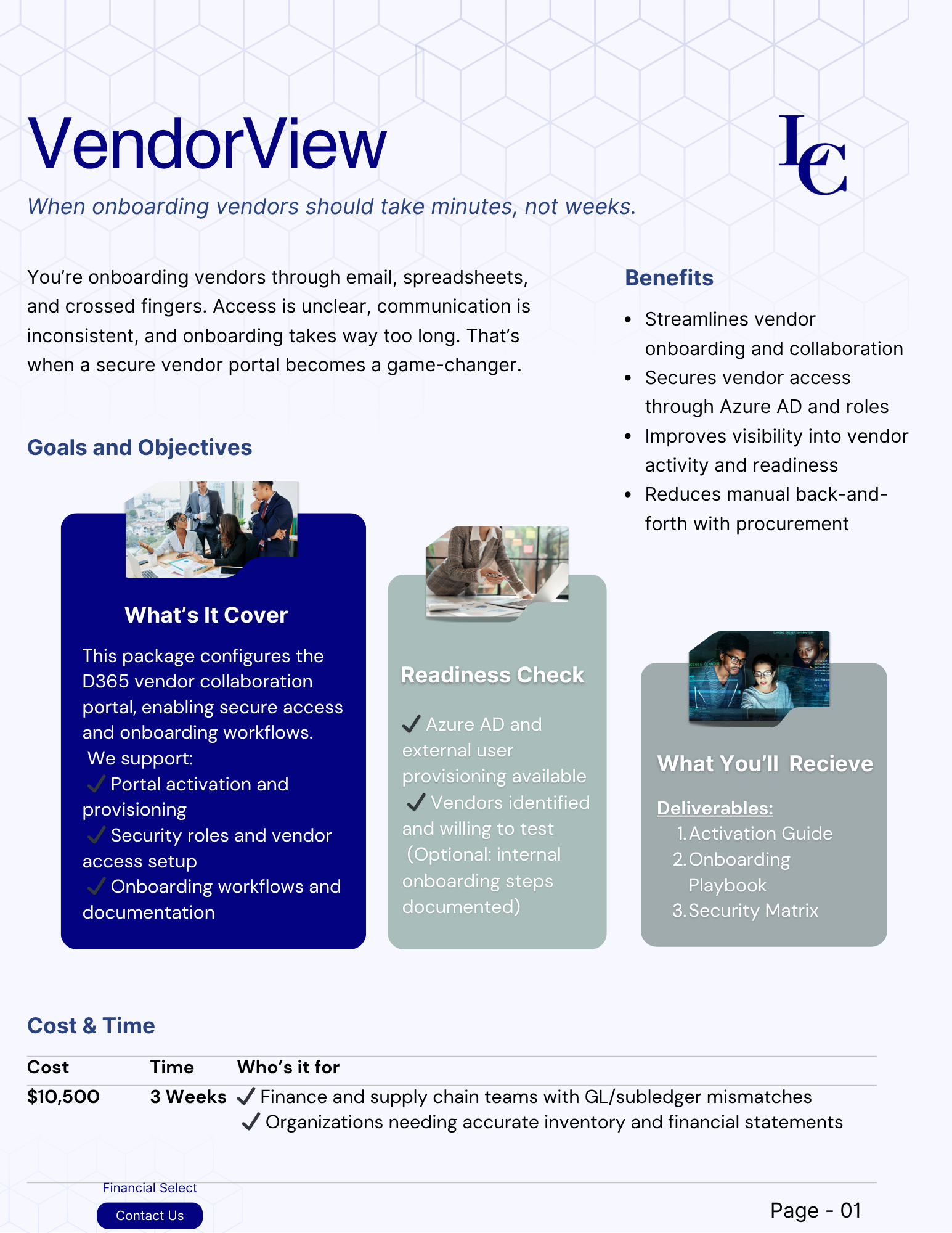


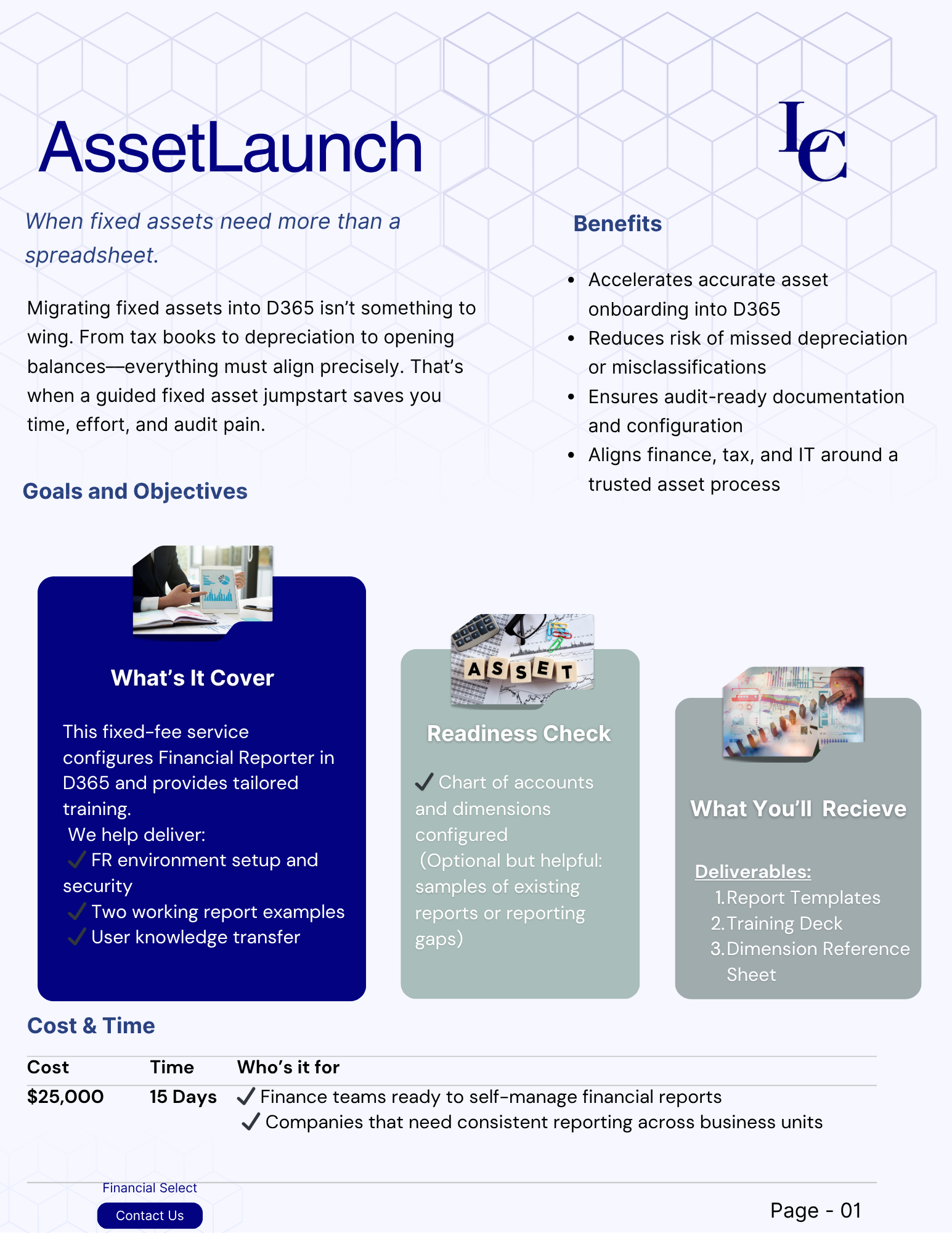
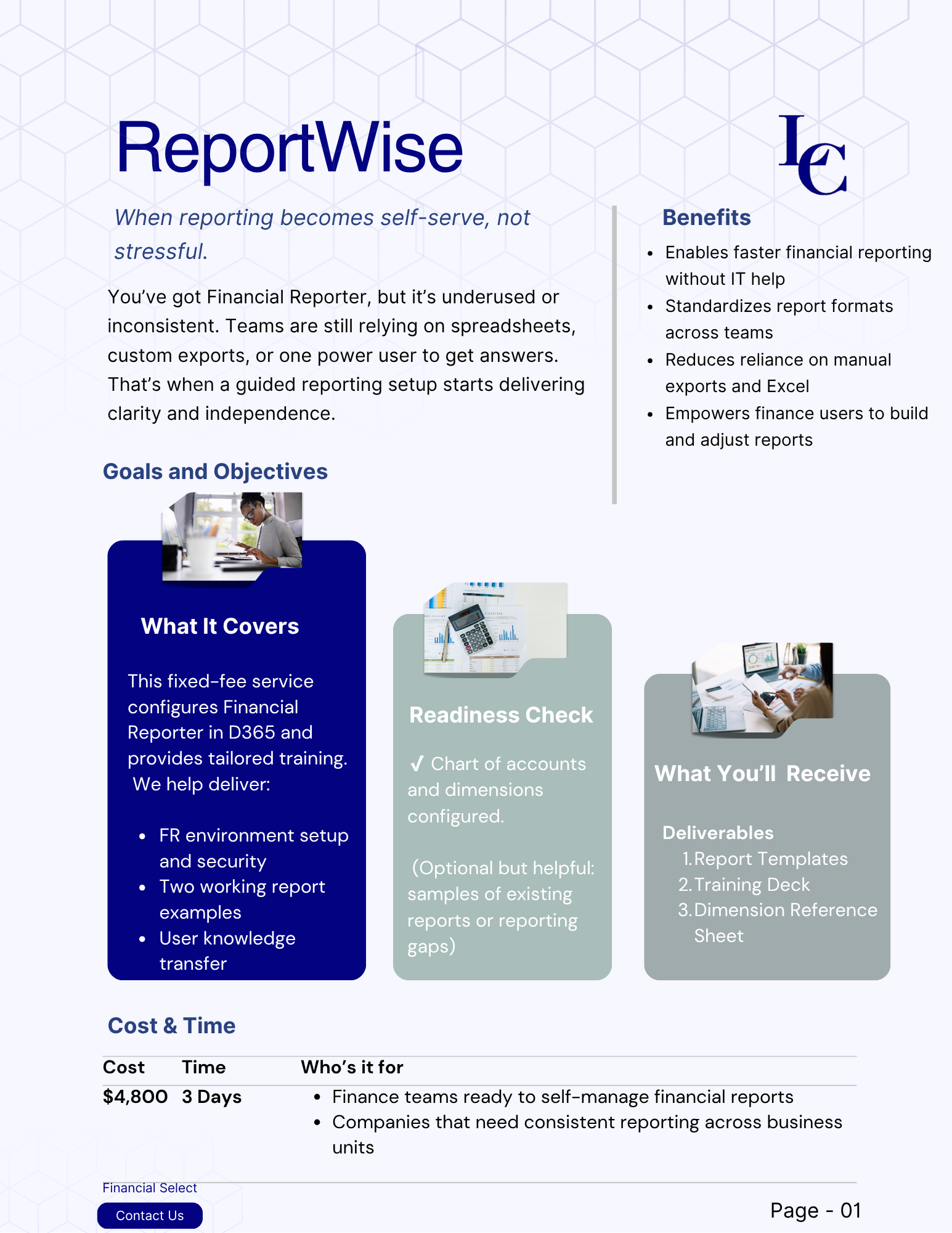
Reviews and corrects ledger-to-subledger alignment in D365 by fixing posting configurations, inventory profiles, reconciliation logic, GL mapping, and critical reporting procedures.
Dollarizing ERP Pain: How to Build a D365 Business Case Finance Will Actually Believe
Posted on: June 30, 2026 | By: Heather Zhu | Microsoft Dynamics AX/365|Microsoft Dynamics Manufacturing, Microsoft Dynamics AX/365

Most Dynamics 365 conversations start in feature language.
Can we automate approvals?
Can we improve inventory visibility?
Can we shorten month-end close?
Can we reduce manual work?
Can we finally retire that spreadsheet with 19 tabs and the emotional stability of a folding chair?
All fair questions. But they are not the questions that get budget approved.
The better question is:
What is the current pain costing us?
That is the shift. D365 initiatives should not begin as software projects. They should begin as financial arguments. If the business cannot quantify the cost of the problem, the project becomes a “nice to have,” and “nice to have” usually loses to whatever is currently on fire.
The framework below expands the core pain areas from the original Logan draft—manual processes, poor visibility, disconnected systems, and compliance/reporting risk—into a more practical decision model for D365 initiatives.
Logan POV: pain gets sympathy. Dollarized pain gets executive attention.
Why “we need better ERP” is not a business case
Executives do not fund “better ERP.” They fund outcomes.
That distinction matters because Microsoft’s own Dynamics 365 implementation guidance emphasizes that successful projects are not just about enabling features. Success by Design is built around proactively identifying business, project, and technical risks so solutions can support mission-critical business processes, not just check configuration boxes. Microsoft notes that Dynamics 365 project teams need to pause and address risks before they become harder to fix later in the project lifecycle.
This is where many organizations get stuck. They know the current state is painful, but they describe that pain operationally:
“Our close takes too long.”
“Inventory is hard to trust.”
“Planning is too manual.”
“Reporting is inconsistent.”
“We have too many workarounds.”
Those are symptoms. A D365 business case needs economics.
A stronger version sounds like this:
“Month-end close requires 220 hours of manual reconciliation per month.”
“Inventory inaccuracies are driving $400,000 in annual expediting and excess safety stock.”
“Disconnected systems require three FTEs to maintain data alignment.”
“Audit preparation consumes 300 internal hours per year before external auditor review begins.”
Now the conversation changes.
You are no longer asking whether the organization wants a new system. You are asking how long it wants to keep paying the old-system tax.
The four questions every D365 initiative should answer
Before debating scope, modules, licenses, or integrations, leaders should force the initiative through four questions.
1. What pain are we solving?
Be specific. “Improve reporting” is too vague. “Reduce manual financial consolidation across six legal entities” is useful.
D365 initiatives work best when tied to a defined business process: order-to-cash, procure-to-pay, plan-to-produce, inventory management, warehouse execution, financial close, project accounting, or service delivery.
If the pain cannot be located in a process, it will be hard to fix in a system.
2. Who feels the pain?
Pain has an owner, even when nobody wants to admit it.
Finance may feel it during close. Operations may feel it through production delays. Procurement may feel it through expediting. Sales may feel it through missed delivery commitments. IT may feel it through fragile integrations. Leadership feels it when every department brings a different version of the truth to the same meeting.
If the pain crosses departments, the initiative should not be owned by one department alone. That is how “ERP improvement” becomes “finance fixed their part and operations kept their workaround.”
3. What does the pain cost?
This is the heart of the business case.
Common cost categories include:
- Labor waste
- Rework and corrections
- Excess inventory
- Stockouts and missed revenue
- Expedite fees
- Delayed billing or collections
- Compliance and audit effort
- IT support and integration maintenance
- Reporting delays
- Customer experience issues
Not every cost is perfectly measurable. That is fine. The goal is not false precision. The goal is credible range-building.
4. What changes if we fix it?
Every D365 initiative should connect pain to measurable outcomes:
- Fewer manual hours
- Faster close
- Lower inventory carrying cost
- Improved on-time delivery
- Reduced order errors
- Faster collections
- Better audit readiness
- Fewer integrations
- Higher planner productivity
- Cleaner reporting
This is where the project becomes investable.
The math: how to dollarize ERP pain
You do not need a 40-page model to start. You need a disciplined estimate.
Manual work and rework
Use:
Hours per week × fully loaded hourly rate × 52 weeks
Then add the cost of downstream errors if those manual steps create rework.
Example: If three employees each spend 10 hours per week reconciling data at a fully loaded rate of $55/hour, that is:
3 × 10 × $55 × 52 = $85,800 per year
That is before you count errors, delays, or opportunity cost.
This category matters because Forrester’s 2024 Total Economic Impact study of Microsoft Dynamics 365 ERP found that a composite organization saw productivity improvements across finance/accounting, supply chain/logistics, and other personnel. The study estimated key personnel saved between seven and 15 hours per week, creating $8.9 million in value over three years for the composite organization. (Forrester)
Inventory pain
Use:
Excess inventory × carrying cost assumption
Then add:
Stockouts × lost gross margin
And:
Expedites × premium cost
Inventory pain is rarely one number. It usually shows up as a cluster: too much of the wrong inventory, not enough of the right inventory, rush freight, production delays, and customer escalations.
If a company carries $2 million in avoidable inventory and estimates a 20% annual carrying cost, that is $400,000 per year in working capital drag. If stockouts also create lost margin, the total pain climbs quickly.
Reporting delays
Use:
Manual report preparation hours + delayed decision cost
This one is harder to quantify, but it is often one of the most strategic.
Late reporting creates slow decisions. Slow decisions create missed opportunities. Finance teams know the numbers eventually. The problem is that “eventually” is not always useful.
Forrester’s 2026 Microsoft-commissioned ERP research specifically connects Dynamics 365 ERP value to unified data, standardized finance and supply chain processes, improved visibility, and faster data-driven decisions. Microsoft’s summary of the enterprise study reports projected 101% ROI and $12.9 million NPV over three years for the modeled organization; the midmarket study reports 16-month payback and $3.3 million NPV. (Microsoft)
Important caveat: these are composite models, not guarantees. But they give CFOs a useful benchmark: ERP value comes from measurable operational improvement, not enthusiasm.
Disconnected systems
Use:
Integration maintenance + duplicate entry + reconciliation + support cost
Disconnected systems are expensive because the cost hides everywhere.
IT maintains fragile integrations. Finance reconciles data mismatches. Operations works from outdated information. Leadership questions reports. Users export to Excel because “it’s faster,” which is often corporate code for “the system does not reflect how work actually happens.”
Forrester’s 2024 Dynamics 365 ERP TEI study estimated reduced infrastructure and IT operations spend from cloud migration at $3.9 million over three years for the composite organization, driven by reducing cost centers associated with on-premises legacy solutions, IT support, disaster recovery, hardware, maintenance, third-party software, and related devices. (Forrester)
Compliance and audit pain
Use:
Audit prep hours + external fees + remediation + penalties/risk exposure
This is one of the most underestimated categories.
Audit pain is rarely just the external auditor invoice. It is the internal scramble: finding support, validating approvals, explaining exceptions, proving controls, documenting manual workarounds, and tracking down the one person who “knows where that file is.”
If your compliance evidence depends on email archaeology, the system is not supporting control. It is supporting panic with attachments.
How to think about D365 initiatives differently
A D365 initiative should not start with:
“Which feature should we turn on?”
It should start with:
“Which pain is expensive enough to justify change?”
That one sentence changes the roadmap.
Instead of a feature wish list, create a pain-to-value map:
- Manual AP processing → workflow automation, invoice capture, approval routing
- Inventory uncertainty → warehouse management, inventory visibility, better item/location governance
- Forecast chaos → demand planning, governance, scenario comparison
- Slow close → standardized financial dimensions, better posting rules, close workspace discipline
- Poor supplier reliability → procurement workflows, vendor performance data, supply risk visibility
- Disconnected reporting → data model cleanup, Power BI, Business Performance Analytics
The point is not to implement everything. The point is to prioritize the initiatives where the business case is clearest.
Logan reality check: the best ERP roadmap is not the longest one. It is the one where every item has a dollar sign, an owner, and a reason leadership should care.
The “cost of waiting” is part of the business case
Many organizations compare project cost against project benefit.
That is only half the math.
The other half is the cost of doing nothing.
If a manual process costs $250,000 per year and the fix costs $100,000, delaying the project six months is not neutral. It may mean another $125,000 of avoidable waste, plus the harder-to-measure cost of frustrated employees, delayed decisions, and missed opportunities.
The most effective business cases frame D365 initiatives in three numbers:
- Current annual pain
- Cost to fix
- Cost of waiting
That third number is the one that usually wakes people up.
What makes a D365 business case credible?
A credible D365 business case has five qualities:
- It is process-based.
It names the process being improved. - It is measurable.
It includes hours, dollars, transaction counts, error rates, cycle times, or working capital impact. - It is conservative.
It does not need heroic assumptions to look attractive. - It has ownership.
Someone owns the metric after go-live. - It connects to strategic value.
It explains how the initiative supports scale, resilience, margin, compliance, customer experience, or faster decision-making.
This matters because Forrester’s TEI methodology explicitly evaluates benefits, costs, flexibility, and risks over time using a financial framework. The 2026 midmarket Dynamics 365 ERP study also notes that Forrester advises readers to use their own estimates within the framework to determine the appropriateness of an investment for their organization. (Forrester)
That is exactly the right mindset. Use benchmark studies as directional evidence. Use your own pain as the business case.
Final thought
ERP pain is easy to describe and hard to fund—until it is dollarized.
Once leaders see what manual work, disconnected systems, inventory distortion, delayed reporting, and compliance friction actually cost, D365 initiatives stop looking like technology projects. They start looking like margin recovery, working capital improvement, risk reduction, and operational control.
That is the better conversation.
Dynamics 365 provides the platform. The business case comes from understanding where money is leaking today and what it would be worth to stop the leak.
Because the real question is not:
“Can we afford to improve the system?”
It is:
“How much are we already paying because we haven’t?”