





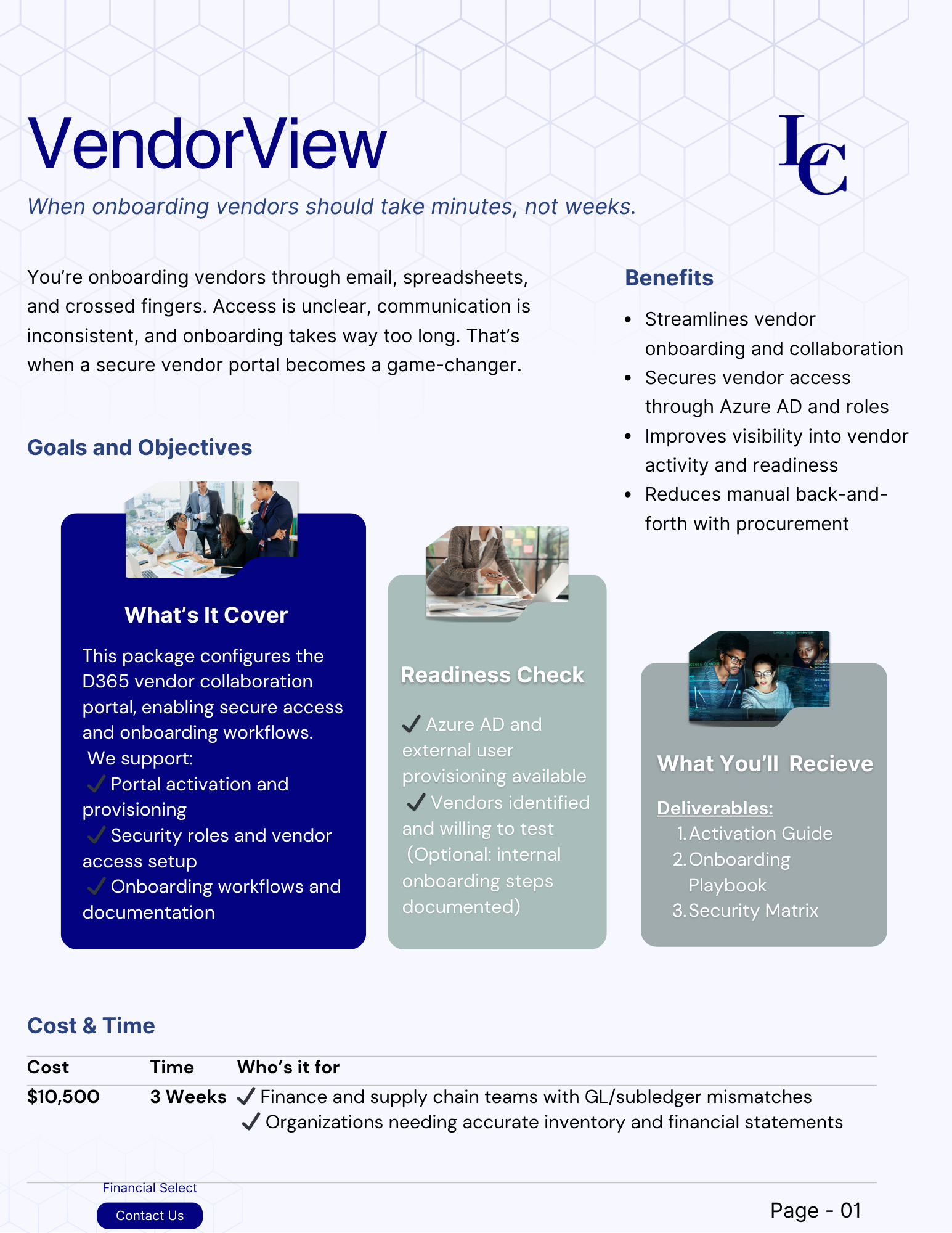


Reviews and corrects ledger-to-subledger alignment in D365 by fixing posting configurations, inventory profiles, reconciliation logic, GL mapping, and critical reporting procedures.
The Hidden Cost of “Band-Aid” EDI Solutions
Posted on: June 25, 2026 | By: Jackson Morris | EDI
Electronic Data Interchange (EDI) has become a critical component of modern business operations, enabling organizations to exchange orders, invoices, shipping notices, inventory updates, and other business documents electronically with customers, suppliers, and partners. As companies grow and trading partner requirements evolve, many organizations find themselves implementing quick fixes to address immediate EDI challenges. While these temporary solutions may solve short-term problems, they often create long-term complications that can significantly impact business performance.

Band-aid EDI solutions typically emerge when organizations prioritize speed over strategy. A new customer requires custom mapping, a supplier changes document specifications unexpectedly, or a business acquisition introduces a new ERP system. Rather than evaluating the broader integration landscape, companies frequently implement isolated fixes designed to meet a specific need as quickly as possible.
Initially, these solutions appear successful. Documents flow, compliance requirements are met, and the immediate business issue is resolved. However, over time, these quick fixes begin to accumulate. Multiple custom maps, manual intervention points, disconnected processes, and undocumented workflows create an increasingly complex environment that becomes difficult to manage and support.
One of the most significant risks associated with band-aid EDI solutions is the creation of technical debt. Every temporary workaround adds another layer of complexity to the integration ecosystem. When trading partners make changes, organizations often discover that seemingly simple updates require extensive testing and modifications across multiple systems. What should be a straightforward enhancement becomes a costly and time-consuming project.
Operational inefficiencies also become more prevalent. Employees may be required to manually review transactions, correct errors, or reprocess documents due to inconsistent integration logic. These manual activities not only increase labor costs but also introduce opportunities for human error. In industries where chargebacks, compliance penalties, and customer satisfaction are closely monitored, these inefficiencies can have direct financial consequences.
Scalability presents another challenge. As transaction volumes increase and new trading partners are added, band-aid solutions often struggle to keep pace. Processes that worked adequately for ten trading partners may become unmanageable with fifty or one hundred. Organizations frequently find themselves investing more time maintaining existing integrations than supporting business growth.
The lack of documentation is another common characteristic of temporary EDI fixes. When key personnel leave the organization, valuable knowledge often leaves with them. New team members are forced to decipher complex mapping logic and undocumented business rules, increasing support costs and prolonging issue resolution times.
The alternative is to adopt a strategic approach to EDI integration. This includes establishing standardized integration frameworks, leveraging scalable integration platforms, maintaining proper documentation, and implementing governance processes that evaluate the long-term impact of proposed changes. While this approach may require greater upfront investment, it significantly reduces maintenance costs and operational risk over time.
Successful organizations view EDI as a business-critical function rather than a series of isolated projects. By addressing root causes instead of applying temporary fixes, they create integration environments that are flexible, scalable, and capable of supporting future growth.
The next time an urgent EDI request arises, it is worth asking a simple question: Are we solving the problem, or are we simply applying another band-aid? The answer may determine the long-term health of your entire integration ecosystem.
Next Steps
Logan Consulting has experience working with its clients to implement successful EDI solutions. To evaluate your EDI solution in more detail, contact Logan Consulting today for a discussion. You can email us at EDIInfo@loganconsulting.com or call (312) 345-8817.