



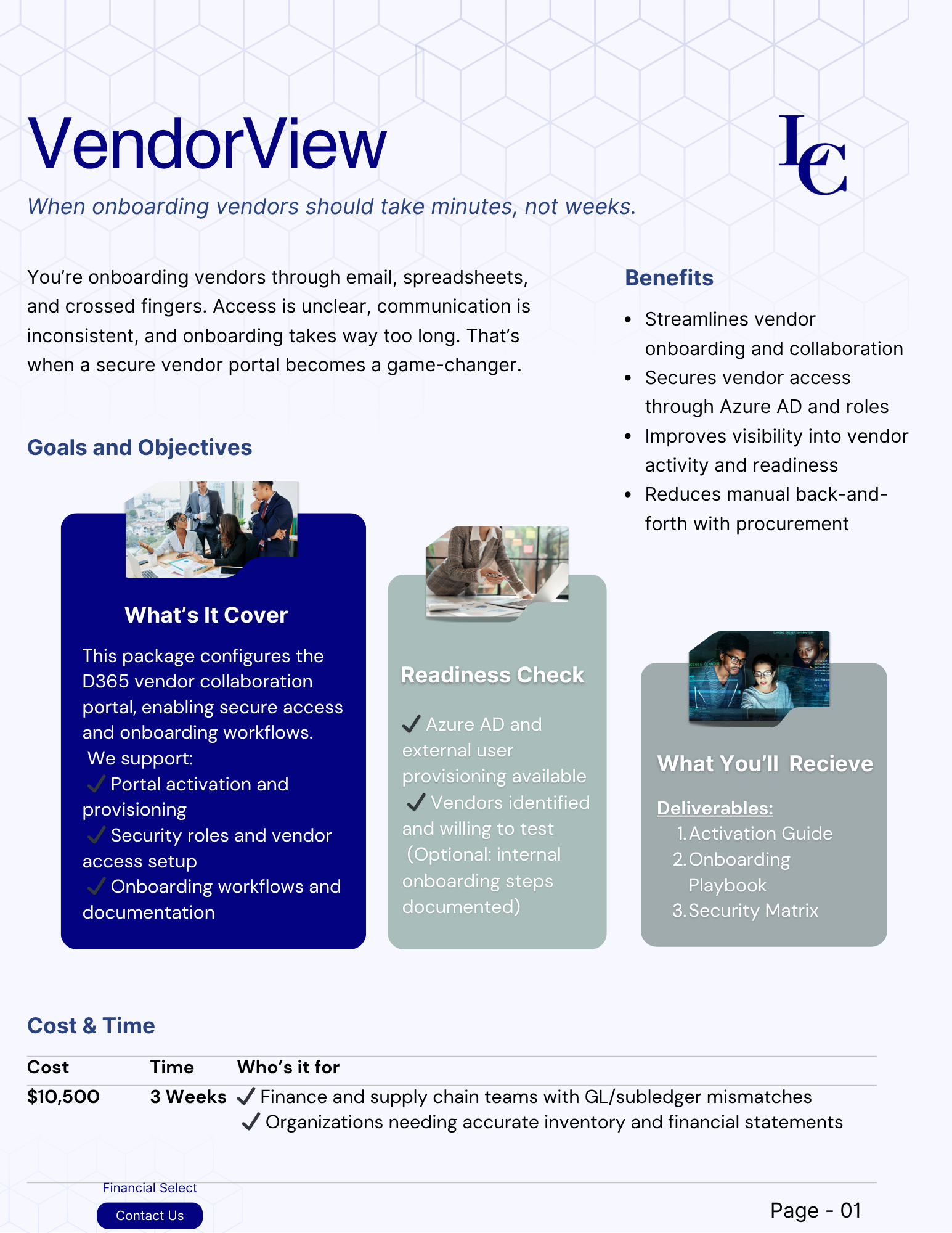


Reviews and corrects ledger-to-subledger alignment in D365 by fixing posting configurations, inventory profiles, reconciliation logic, GL mapping, and critical reporting procedures.
What You Gain in Functionality Moving from Dynamics GP to Business Central
Posted on: July 14, 2026 | By: Jackson Morris | Microsoft Dynamics Business Central
For years, Microsoft Dynamics GP has been a dependable financial management system for small and midsized businesses. But as organizations grow through adding locations, expanding product lines, or taking on more complex reporting requirements, many finance and operations teams start running into the limits of what GP was originally built to handle. Reports take longer to pull together, financial data ends up scattered across disconnected spreadsheets, and IT spends more time keeping the system running than helping the business move forward.
Microsoft Dynamics 365 Business Central was designed to solve these problems. It is not simply a newer version of GP; it is a modern, cloud-based ERP platform with functionality that extends well beyond what GP offers today. For organizations evaluating a move, understanding exactly what capabilities they gain, not just what changes, is the key to building a strong business case.

Real-Time, Role-Based Reporting
One of the most immediate gains in Business Central is reporting. GP users are often familiar with exporting data to Excel or relying on Management Reporter and SmartLists to piece together financial pictures. Business Central changes this by embedding Power BI dashboards directly into the user experience, giving finance leaders live visibility into cash flow, budget performance, and operational metrics without leaving the system.
Because dashboards are role-based, a controller, a warehouse manager, and a sales director each see the data most relevant to their responsibilities the moment they log in. This reduces the manual reporting work that often falls on finance teams at month-end and gives leadership faster access to the numbers they need to make decisions.
Deeper Integration Across the Business
GP was built primarily as a financial management system, with other functions often bolted on through third-party add-ons. Business Central takes a more unified approach. Inventory, purchasing, sales, service management, and project accounting are native modules that share the same data structure as the general ledger, which means fewer integration points to maintain and fewer opportunities for data to fall out of sync.
This matters most for organizations that have outgrown GP’s core financial focus and need tighter connections between operations and accounting. A manufacturer tracking work orders, a distributor managing multiple warehouses, or a services firm billing against project budgets all benefit from having these processes run on a single platform rather than stitched together across systems.
Built-In Automation and AI
Business Central includes workflow automation and AI capabilities that were never part of GP’s design. Approval workflows for purchase orders, vendor payments, and journal entries can be configured without custom development. Copilot features embedded in the platform can help draft item descriptions, flag anomalies in financial data, and suggest actions based on patterns the system detects.
For finance teams that have relied on manual approval routing or email chains, this kind of automation cuts down on delays and creates a clearer audit trail. It also reduces the administrative burden on IT, since much of this functionality is configured rather than custom-coded.
Cloud Access and Scalability
GP was designed for on-premises deployment, and while hosted versions exist, the platform was not built cloud-native. Business Central runs natively in the cloud, giving organizations browser and mobile access to their ERP system from any location. This has become increasingly important as more finance and operations teams support hybrid or remote work.
Cloud deployment also changes how the system scales. Adding users, storage, or new company entities does not require the same infrastructure planning that GP often demands. For organizations opening new locations or entities, or preparing for growth through acquisition, this flexibility removes a common bottleneck.
A Platform Built for What Comes Next
Microsoft has been clear that its long-term investment in ERP innovation, including AI-driven tools, is centered on Business Central rather than GP. Organizations that stay on GP will continue to have access to the system, but new functionality, deeper AI integration, and platform enhancements are being built for Business Central going forward. That gap in ongoing innovation is one of the clearest functional differences between the two systems today.
For businesses planning several years ahead, this matters beyond the current feature set. Choosing a platform that continues to evolve reduces the risk of falling behind on reporting expectations, security requirements, and the automation tools competitors are already adopting.
Next Steps
Moving from Dynamics GP to Business Central is as much a functionality upgrade as it is a platform change. Organizations gain real-time reporting, tighter integration across operations and finance, built-in automation, and a cloud-native foundation that supports growth in ways GP was never designed to.
Logan Consulting helps organizations evaluate their current GP environment, map existing processes to Business Central, and plan a migration that minimizes disruption while unlocking these new capabilities. If your organization is weighing what a move to Business Central would mean for your day-to-day operations, contact Logan Consulting today to start planning your transition.