



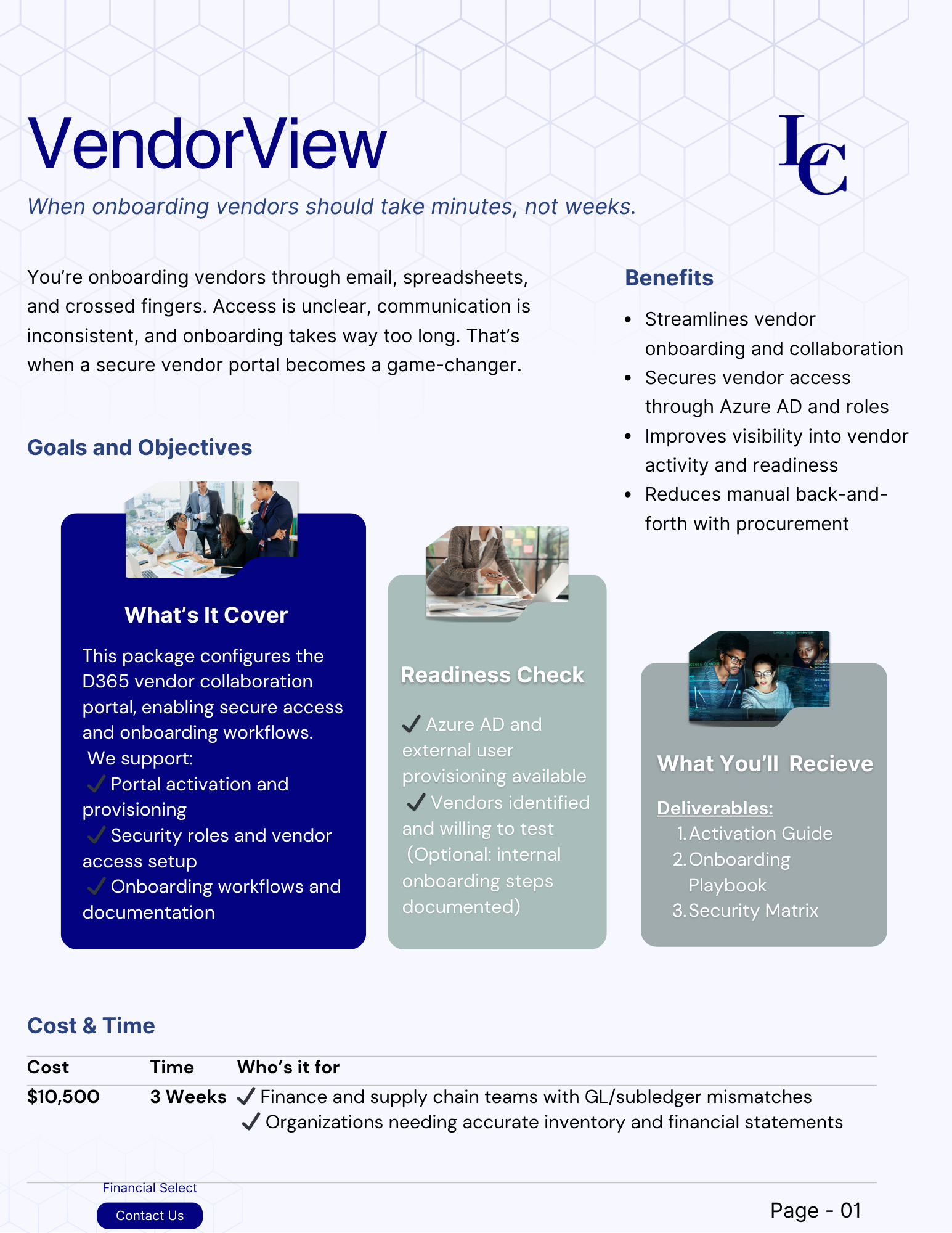


Reviews and corrects ledger-to-subledger alignment in D365 by fixing posting configurations, inventory profiles, reconciliation logic, GL mapping, and critical reporting procedures.
NetSuite Implementation Readiness Checklist: What Every Organization Should Prepare Before Go-Live
Posted on: June 15, 2026 | By: Anika Dewjee | NetSuite
Implementing NetSuite is far more than a software deployment — it is a business transformation initiative that impacts processes, reporting, controls, integrations, and day-to-day operations across the organization. Companies that invest time upfront in preparation consistently reduce project risk, improve adoption, and accelerate ROI.
Below is a practical checklist to help organizations prepare for a successful NetSuite implementation while accounting for modern considerations such as AI enablement, governance, and scalable architecture.

1. Establish Executive Alignment and Governance
Successful ERP projects require strong executive sponsorship and clear decision-making authority. Define:
- Executive sponsors
- Steering committee members
- Project manager responsibilities
- Escalation paths
- Approval and change control processes
Without governance, ERP projects often suffer from scope creep, delayed decisions, and inconsistent priorities. Governance becomes even more critical when AI tools and automation are introduced, as organizations must determine who owns data quality, automation approvals, and exception management.
2. Document Current-State Business Processes
Before configuring NetSuite, organizations should fully understand how work is performed today across:
- Finance
- Procurement
- Inventory
- Manufacturing
- Order management
- CRM
- Warehouse operations
Many companies attempt to implement software before clearly identifying process inefficiencies or manual workarounds. This often results in simply recreating broken processes inside a new ERP system.
Conduct workshops to identify:
- Pain points
- Duplicate activities
- Spreadsheet dependencies
- Manual approvals
- Reporting gaps
- Bottlenecks
3. Design Future-State Processes
A successful implementation should improve operations — not merely replace systems. Future-state design should focus on:
- Standardization
- Automation
- Scalability
- Internal controls
- KPI visibility
- Reduced manual effort
Organizations should carefully evaluate where AI can improve operational efficiency, such as:
- Automated invoice processing
- Predictive demand planning
- Intelligent reporting
- Workflow recommendations
- Customer service automation
However, AI should support defined business processes — not replace operational discipline.
4. Validate Data Quality Early
Poor data is one of the leading causes of ERP implementation delays. Begin cleansing and validating:
- Customers
- Vendors
- Inventory
- BOMs
- Pricing
- Open transactions
- Financial dimensions
- AI-driven analytics and forecasting tools are only as effective as the data feeding them. Inaccurate or inconsistent data can create misleading AI outputs and poor business decisions.
5. Define Integration and Architecture Standards
ERP architecture decisions made early in the project can significantly impact long-term scalability and supportability. Organizations should evaluate:
- Integration requirements
- Middleware strategy
- API standards
- Reporting architecture
- Security model
- Data ownership
Avoid creating overly customized environments that become difficult to maintain. A strong architecture balances flexibility with long-term sustainability.
6. Evaluate Customizations Carefully
One of the most common ERP mistakes is excessive customization. While NetSuite offers extensive flexibility, organizations should first determine whether process changes can eliminate the need for custom development.
Every customization introduces:
- Additional testing
- Upgrade considerations
- Technical debt
- Increased support costs
AI tools may accelerate development, but they also increase the risk of poorly governed customizations being deployed too quickly without proper validation.
7. Build a Change Management and Training Strategy
Even the best ERP implementation will fail without user adoption. Organizations should prepare:
- Role-based training
- Super user programs
- Communication plans
- Process documentation
- Testing ownership
Employees must understand not only how to use the system, but why processes are changing.
Next Steps
A successful NetSuite implementation starts with proper planning. Logan Consulting helps organizations prepare for go-live by optimizing processes, ensuring data readiness, and building scalable ERP environments.
If you’re evaluating NetSuite or preparing for an implementation, contact Logan Consulting to learn how we can help set your project up for long-term success.
 NetSuite SuiteConnect Chicago 2026: Connect, Learn, and Lead With ERP Innovation
 Highlights from NetSuite Lunch and Learn and Happy Hour in New York: Strengthening Partnerships and Delivering Value
 A Strategic Shift at Oracle and What It Means for NetSuite Customers
 Extending Your Functionality with the NetSuite SuiteApp Marketplace