


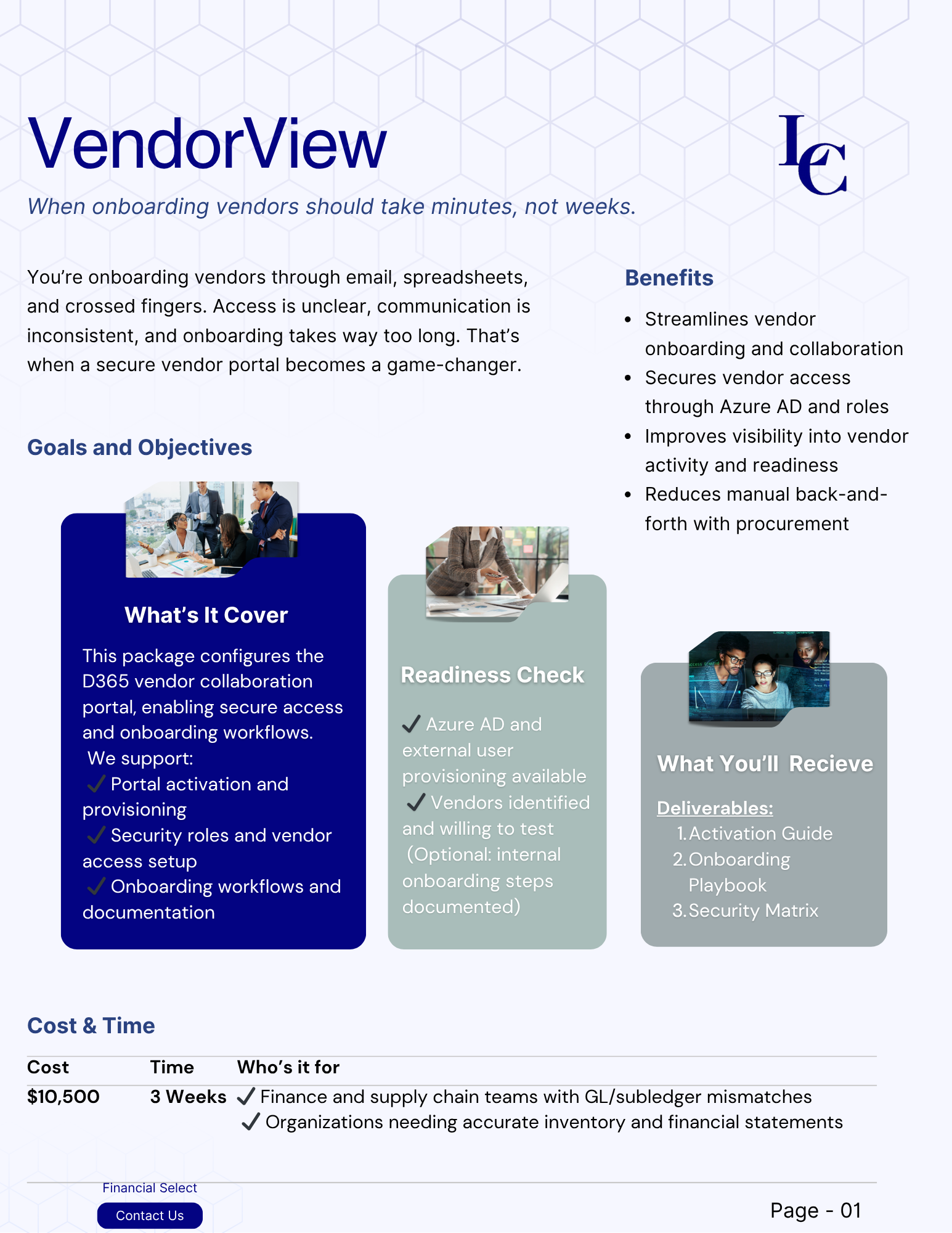


Reviews and corrects ledger-to-subledger alignment in D365 by fixing posting configurations, inventory profiles, reconciliation logic, GL mapping, and critical reporting procedures.
Summit 2026: The Real Story Was the Work Between the Systems.
Posted on: October 21, 2026 | By: Heather Zhu | Microsoft Dynamics AX/365, Microsoft Dynamics AX/365|Microsoft Dynamics Manufacturing
Nashville / October 11-15, 2026
Microsoft’s direction, the practical lessons beneath the AI headlines, and Logan’s view of what deserves a place on your roadmap.
By Logan Consulting • October 22, 2026 • 7-minute read
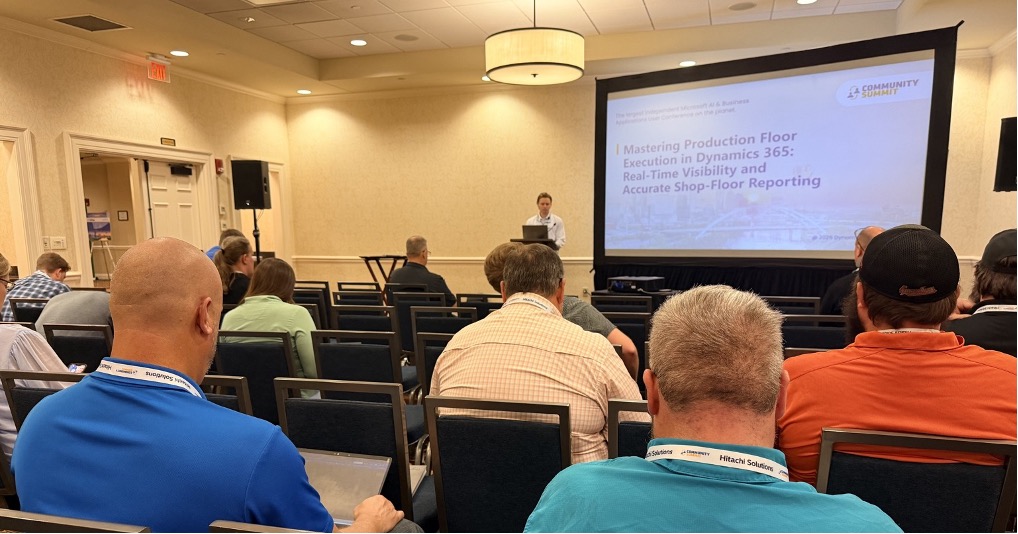
Beyond the headline demos: production-floor execution and accurate reporting remained part of the practical conversation. Photo: Kyle Valerio.
The keynote opened to Dolly Parton’s “9 to 5.” An appropriate soundtrack for a conference asking how much of the working day should still disappear into searching, updating and chasing. John Siefert’s invitation to “double down on the critical thinking aspect” was equally well chosen.
The Logan Value Statement
The value of Dynamics is the distance it removes between a business signal and a trusted action.
Community Summit North America brought more than 5,500 attendees and 600 sessions to Nashville, according to the organizers. Their recap video and written session coverage are now available. For anyone who missed the event, these are the developments worth understanding. For attendees, they are the threads worth connecting.
01 / The Refresher
What the platform sessions actually said
Finance & Supply Chain: reduce the coordination tax
Microsoft’s Georg Glantschnig described the time lost finding information, chasing responses and navigating approvals as a “coordination tax.” Amanda Hillman’s demand-planning demonstration connected a market opportunity with capacity, financial implications and cross-functional approvals. An employee retained final approval, with an audit trail before approved changes reached business systems.
Customer discussions supplied the less theatrical context. Traditional Medicinals described standardizing operations for growth; Mid-Continent Instruments and Avionics described the reporting and data work behind its evolving Dynamics environment. These were customer stories presented at Summit, not Logan case studies.
Logan’s read: the opportunity is not merely a faster planning screen. It is a shorter, more reliable journey from changed demand to an authorized operating decision.
Business Central: practical depth alongside the agents
The BC/NAV session covered financial-report scheduling, manufacturing improvements, cross-environment master data, document layouts and Fabric connectivity. Microsoft’s Aleksandar Totovic also demonstrated sales-order, payables and expense agents, with employees involved in decisions and exceptions. This was broader than a chatbot story.
Logan’s read: do not overlook an ordinary reporting, manufacturing or data-management improvement because a more photogenic AI demonstration followed it. Assess the specific feature and its availability, not the umbrella label.
Customer Engagement: make CRM useful to the seller
“We want to change Dynamics from a system of record to a system of action,” Microsoft’s Mike Morton said. The CE/CRM session connected preparation, follow-up and prioritization with context across Dynamics, Outlook, Teams and other Microsoft applications. Customer Insights and unified customer information extended that discussion into marketing.
Logan’s read: better CRM adoption should follow better daily usefulness. A system that helps someone advance a customer conversation has a stronger proposition than one that merely asks for another update.
Power Platform: improve the work already in place
Dona Sarkar and Leon Welicki demonstrated an AI coding agent improving accessibility in an existing Power App. The useful distinction was augmentation, not wholesale replacement: apply assistance to a specific job inside an existing application. A demonstration establishes a direction to investigate, not universal production availability.
02 / The Logan Interpretation
A bigger platform needs clearer boundaries
Our reading of Summit is that the competitive question is moving beyond which application has the most AI. The more consequential question is which business can connect its information, decisions and execution without creating another layer of manual coordination. That is a different buying conversation.
The finance roundtable made the economic motivation tangible. Copper State Bolt & Nut discussed supporting growth when hiring could not keep pace. Manufacturing and distribution leaders, meanwhile, raised fragmented systems, data cleanup and the need to define the business problem before selecting AI. These accounts are useful signals, not a representative market survey.
Finance roundtable coverage · Manufacturing and distribution roundtable
For a manufacturer or distributor, the most valuable next step may be a reliable production signal, a quicker response to a supply exception, or a customer promise that operations can actually keep. None becomes more valuable simply because an agent is involved. Equally, the right automation may create capacity that a team cannot obtain by hiring quickly enough.
The ecosystem is an advantage only when someone owns the joins
Microsoft, specialist software providers and implementation partners play different roles. Our recommendation is to evaluate standard Dynamics functionality first, then add specialist software or custom work where a specific requirement justifies it. More choice is useful. More overlapping responsibility is not.
Consider an illustrative customer-date change: CRM records the request, planning assesses supply, a workflow obtains approval, and the confirmed promise returns to the customer. Ask who owns the record at each step, who may approve the change, what happens when the integration fails, and how the business confirms completion. Buying four capable components does not answer those questions.
| Signal | Context | Authority | Action | Evidence |
|---|---|---|---|---|
| What changed? | Which data is trusted? | Who may decide? | What is committed? | How is it verified? |
Logan’s review lens: trace the entire handoff, including the point where automation must stop.
A stage demonstration is not a deployment commitment
One useful reality check: the organizer’s BC recap describes Fabric mirroring as public preview. Microsoft’s FAQ, retrieved October 21, still labels it private preview, with public preview expected in the coming weeks. These sources disagree on that detail. Treat it as preview-stage and verify the target version, tenant access and terms before committing to a rollout. Microsoft also specifies that Fabric capacity charges apply.
BC/NAV session recap · Microsoft’s Fabric mirroring FAQ
For Dynamics GP owners, modernization has an additional planning clock. Microsoft lists December 31, 2029 for the end of product enhancements, regulatory updates and technical support, with security updates and patches, if needed, through April 30, 2031. Those are support-planning facts, not new announcements we are attributing to Summit.
03 / From Our Team to Your Next Decision
The practical expertise worth bringing home
Sarah Massie: trust the report before acting on it
Sarah’s Power BI session used Business Central data to explain connections, source selection, data modeling and meaningful reporting. She also covered pitfalls affecting accuracy and performance. Our takeaway: a polished dashboard needs a dependable explanation of where its numbers came from.
Bryan Taras: connect the journey, not just the pipeline
Bryan’s session connected marketing activity with Dynamics 365 and the path from first touch to closed deal. Shared sales-and-marketing data, lead quality and campaign measurement were central themes. Our takeaway: customer engagement improves when teams can see and act on the same customer story.
Andrew Beck: keep the shop floor in the conversation
Andrew contributed a production-floor execution demonstration, a useful reminder that an ERP strategy must reach the people doing the work. Our takeaway: visibility is only useful when operational reporting is timely, accurate and usable in the daily process.
The Common Thread
Reliable information. Connected decisions. Practical execution. These are not the unglamorous prerequisites to the strategy. They are the strategy.
What to do with the notebook now
Over the next 30 days, choose one cross-functional problem and one business owner accountable for the result, including the handoffs outside their department.
For the illustrative customer-date change, use a sandbox to test a request that should succeed and one that should be rejected or escalated. Check that authorized updates reach the correct records, unauthorized changes are blocked, and integration failures reach a named owner. Route communications to test recipients. These are proposed tests, not executed tenant results.
Retain the records, approvals and exception history. Measure time to a confirmed customer answer and subsequent corrections, not merely recommendation speed.
Then decide: improve the process, deploy a supported capability, evaluate a preview, or wait for a dependency. A reasoned “not yet” beats an impressive backlog nobody owns.
Bring Logan the Summit idea you are still debating. Our business-driven approach connects the platform, process and people so the next step is useful, not simply new.
Remember One Thing
The best Summit takeaway is not the feature you can describe. It is the business decision you can now make better.