



Reviews and corrects ledger-to-subledger alignment in D365 by fixing posting configurations, inventory profiles, reconciliation logic, GL mapping, and critical reporting procedures.
Global Inventory Accounting Is Retiring. Your Mandatory Feature List Just Got Longer
Posted on: August 11, 2026 | By: Heather Zhu | Microsoft Dynamics AX/365
What version 10.0.49 quietly retires, and the mandatory changes that are more likely to catch you off guard.

EXECUTIVE TAKEAWAY
Dynamics 365 Finance and Supply Chain Management version 10.0.49 retires Global Inventory Accounting on a path to end of support in July 2027, and removes a Copilot preview capability with no direct replacement. The bigger near-term risk sits elsewhere: the release makes a long list of Finance and Supply Chain Management features mandatory, closing off the old behavior as an escape route for anyone with custom settlement logic, bank integrations, quality management extensions, or rebate solutions built around it.
ERP deprecation notices are a little like a check engine light. Easy to ignore when everything appears to be running, considerably more expensive once something starts making noise.
Dynamics 365 Finance and Supply Chain Management version 10.0.49 is currently in preview, with self-update availability planned for September 2026 and automatic updates beginning in October.The release includes important deprecations, but the more immediate risk for many companies may be features that become mandatory or permanently embedded in the application.
First, Know What Microsoft Means
Microsoft uses several terms that sound similar but have very different implications.
| Term | What It Actually Means |
|---|---|
| Deprecated | The functionality remains available but is no longer being actively developed and may be removed later. |
| Removed | The functionality is no longer available. |
| On by default | The feature activates automatically, but administrators can still disable it. |
| Mandatory | The feature can no longer be turned off. |
| Removed from Feature management | The functionality remains in the product permanently. The rollback switch has simply disappeared. |
LOGAN POV
That last distinction matters most. “Removed from Feature management” does not mean removed from Dynamics 365. It means the training wheels, and your ability to turn the feature off, are gone.
Global Inventory Accounting Is Being Retired
The largest new deprecation is Global Inventory Accounting (GIA). Microsoft states that GIA will reach end of support on July 1, 2027. The solution is being replaced by a new multi-ledger costing capability intended to deliver comparable functionality on an improved architecture. Microsoft’s deprecation notice advises production users to begin assessing dependencies and planning their transition now.
GIA supports inventory valuation across multiple accounting representations, currencies, and costing methods. That means this is not simply a feature-toggle exercise for companies actively using it. A transition could affect:
- Inventory valuation and cost-of-goods-sold reporting
- Parallel accounting requirements
- Reconciliation between inventory and the general ledger
- Historical reporting and opening balances
- Integrations or custom reporting built around GIA data

Microsoft has described broader investments in multi-ledger accounting, shared hierarchies, and global financial operations, but detailed migration guidance and final capability parity should be validated before committing to a transition design. Microsoft’s financial operations roadmap provides the direction, but direction is not yet a project plan.
LOGAN POV
If GIA is installed but unused, remove it from future designs. If it is running in production, begin documenting valuation models, reporting dependencies, and reconciliation requirements immediately. July 2027 sounds distant, until budgeting, design, testing, and audit approval enter the conversation.
A Copilot Preview Is Also Disappearing
Microsoft is removing the preview capability that allowed follow-up questions in the Finance and Operations Copilot sidecar. It never reached general availability and has no direct replacement.
For most organizations, the business impact will be small. The larger lesson is more important: preview functionality should be treated as an experiment, not as a permanent operating dependency. If training materials, demonstrations, or process designs reference this capability, they should be updated.
The Bigger Near-Term Risk: Mandatory Features
The Finance 10.0.49 release makes numerous capabilities mandatory, including customer and vendor netting, cash-position functionality, and several advanced bank-reconciliation behaviors. The Supply Chain Management release makes a separate set of features mandatory.
| Product | Newly Mandatory Features |
|---|---|
| Dynamics 365 Finance |
|
| Dynamics 365 Supply Chain Management |
|
Making a feature mandatory does not automatically mean every customer will begin using it. Configuration still matters. However, it does mean Microsoft is eliminating the old behavior as an escape route.
LOGAN REALITY CHECK
The greatest exposure is likely in environments with custom settlement logic, bank integrations, quality-management extensions, Inventory Visibility connections, direct-delivery customizations, or rebate solutions. Regulated manufacturers should pay particular attention to advanced quality management, since it introduces capabilities involving CAPA, electronic signatures, sampling, calibration, and electronic batch records.
Other Deadlines Worth Including in the Review
Several nearby deprecations should be evaluated during the same assessment.
| Item | Deadline |
|---|---|
| Microsoft maintenance and distribution of the Asset Management mobile app | Ends November 30, 2026. Existing installations can continue, but the app becomes an open-source sample, shifting more maintenance responsibility to customers and partners. |
| Data Integrator templates supporting the Field Service integration | No longer available after February 28, 2027 |
| RSAT support for on-premises deployments | Ends May 15, 2027 |
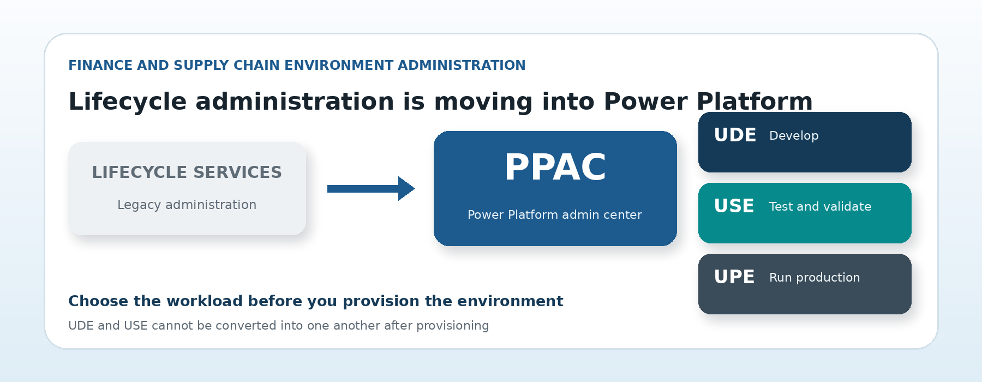
| New cloud implementation projects for Finance and Supply Chain Management | Now begin in the Power Platform admin center rather than Lifecycle Services |
How to Protect the Business
A practical response does not require a massive upgrade project. It requires disciplined release governance.

- Create a feature-impact register. Map every mandatory or deprecated feature to business processes, integrations, customizations, ISVs, and process owners.
- Compare production with sandbox. Do not assume feature states, configuration, or code are identical.
- Test complete business processes. Prioritize record-to-report, procure-to-pay, order-to-cash, bank reconciliation, quality, direct delivery, rebates, and inventory availability.
- Assign named owners and deadlines. “IT is looking at it” is not an accountable migration plan.
- Keep preview functionality out of critical-path designs. Innovation is welcome; operational dependency requires a higher standard.
THE CORE LOGAN POSITION
The broader message from Microsoft is clear. Dynamics 365 is continuing to standardize its architecture and retire older paths, which is generally good for performance, security, and future innovation. But automatic updates do not automatically produce business readiness. That gap is closed by governance, not by the update schedule.