



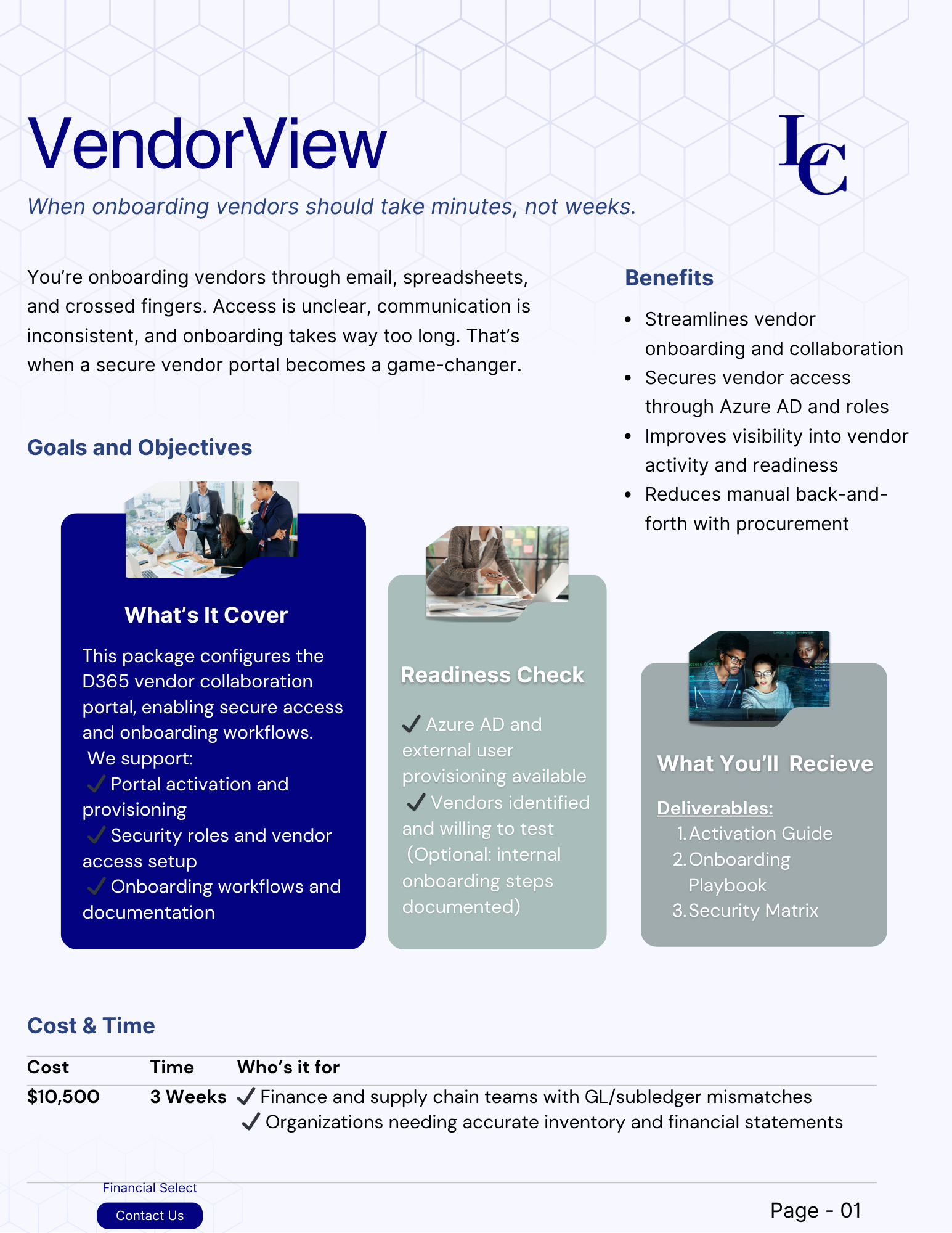


Reviews and corrects ledger-to-subledger alignment in D365 by fixing posting configurations, inventory profiles, reconciliation logic, GL mapping, and critical reporting procedures.
Business Central and the Government Cloud: What Contractors Need to Know
Posted on: August 27, 2026 | By: Jackson Morris | Microsoft Dynamics Business Central
Government contractors working with the Department of Defense are under new pressure to prove where their data lives and how it is protected. With the Cybersecurity Maturity Model Certification (CMMC) program now in effect, many finance and operations leaders assume their entire technology stack, including their ERP system, needs to move into a government cloud environment. For organizations running Business Central, that assumption is worth examining closely, because the actual requirements are more specific than they first appear.

What “Government Cloud” Actually Means
Microsoft’s government cloud offerings, Government Community Cloud (GCC) and GCC High, were built for the Microsoft 365 productivity suite and a select group of Dynamics 365 applications. These environments are designed to help organizations meet FedRAMP authorization levels, DFARS 252.204-7012 flowdown requirements, and NIST SP 800-171 security controls. Business Central is not included in that GCC or GCC High footprint. It runs on Azure Commercial infrastructure, the same environment used by most standard business applications.
This distinction matters because it is easy to assume that any Microsoft product automatically inherits defense-grade compliance simply because it comes from the same vendor. Knowing exactly where Business Central operates is the starting point for building an accurate compliance picture, rather than a false sense of security.
Why This Matters for Government Contractors
The DoD’s CMMC final rule took effect in November 2025, and contracting officers now confirm a contractor’s certification status before awarding work. For companies that handle Controlled Unclassified Information, or CUI, this has raised the stakes for every system that touches contract, financial, or project data connected to a defense relationship.
Business Central frequently holds information adjacent to CUI, such as contract values, vendor records, and project financials, even when it is not the system of record for controlled data itself. Contractors need to identify exactly which systems touch which categories of data before assuming their current ERP setup already satisfies compliance requirements.
Where Business Central Fits in a Compliance Strategy
GCC High is built as a physically and logically separated environment specifically for organizations handling CUI and export-controlled data, and Business Central does not currently run inside that GCC High environment. Because of this, most contractors keep CUI-bearing systems, such as email and file storage, inside Microsoft 365 GCC High, while running Business Central separately on commercial infrastructure. This kind of split environment is common and workable, but it requires intentional planning around data segregation, access permissions, and the integration points that connect the two systems.
For contractors working toward CMMC Level 2 requirements, that planning often includes limiting how much CUI is stored directly in Business Central, applying role-based security to restrict sensitive fields, and documenting the data flow between Business Central and any GCC High systems already in place.
Best Practices for a Compliance-Minded ERP Setup
Start by classifying data rather than systems. Financial and operational records in Business Central are typically lower risk than technical drawings, specifications, or export-controlled files, which belong in GCC High. Once data is classified, access controls, audit logging, and documented data flows between systems make it far easier to demonstrate compliance during an assessment.
Most contractors find it helpful to work with both an ERP partner and a compliance-focused IT provider, since these two areas of expertise rarely overlap within a single vendor.
Next Steps
Business Central can support government contractors, but only when it is deployed with a clear understanding of where compliance boundaries actually sit. Logan Consulting helps midmarket contractors configure Business Central for proper data segregation, security roles, and integration with broader compliance environments. If your organization needs help mapping where Business Central fits into your CMMC strategy, contact Logan Consulting today to start the conversation.
 Scaling EDI as You Grow with Dynamics 365 Business Central
 NetSuite SuiteConnect Chicago 2026: Connect, Learn, and Lead With ERP Innovation
 Highlights from NetSuite Lunch and Learn and Happy Hour in New York: Strengthening Partnerships and Delivering Value
 Forward Deployed Consulting in the Era of NetSuite Next