




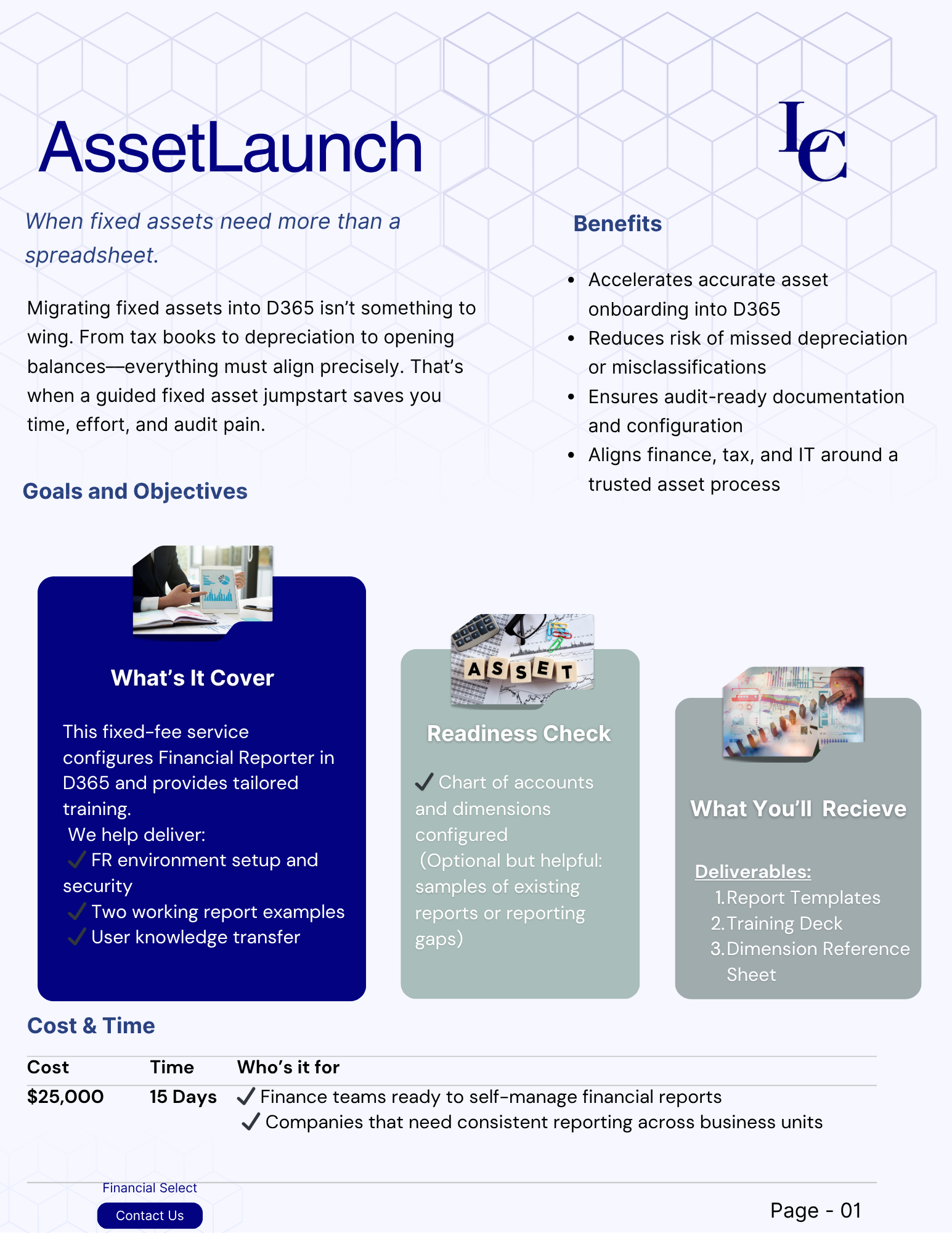
Reviews and corrects ledger-to-subledger alignment in D365 by fixing posting configurations, inventory profiles, reconciliation logic, GL mapping, and critical reporting procedures.
Supply Chain’s AI Agent Reality Check: What D365 Actually Delivers in 2026
Posted on: August 25, 2026 | By: Heather Zhu | Microsoft Dynamics AX/365

LOGAN CONSULTING · AUGUST 2026 | Companion to Logan’s free Field Guide to Dynamics 365 Agents
Executive Perspective
The honest agent list is shorter, and more useful, than the hype
As of August 2026, Microsoft’s finance-and-operations overview documents one named first-party AI agent experience for Dynamics 365 Supply Chain Management: the Supplier Communications Agent. Microsoft’s detailed SCM documentation presents the broader managed experience as the Procurement Agent, combining supplier communications with impact analysis. That is the current out-of-the-box agent anchor.
The SCM opportunity is still much larger than one agent. Native Copilot features already analyze demand plans, summarize warehouse workloads and condense operational records. Microsoft also highlights partner-built agents for warehouse advice, inventory rebalancing and inbound loads. Finally, the dynamic Dynamics 365 ERP Model Context Protocol server makes governed custom agents possible across nearly any user-accessible F&O process.
Logan Point of View
Do not judge the market by the length of the agent catalog. Judge it by whether a supply-chain signal can become a governed decision and a traceable D365 action before service, inventory or margin is lost.
|
1 Named D365 SCM agent The first-party list today |
4 Capability layers Managed, native, partner, custom |
5 Decision steps Signal → context → reason → decide → learn |
4 stages Authority model Observe → recommend → approve → automate |
The current landscape in one page
| First-Party Agent | Procurement Agent / Supplier Communications Agent, production-ready preview |
| Native SCM Copilot | Demand-plan analysis, warehouse workload insights and AI page summaries |
| AI Preview | Generative insights for Demand planning, seasonality and signal correlation |
| Partner Agents | Microsoft-highlighted inventory-to-deliver solutions; separate products and diligence |
| Custom Agents | Copilot Studio plus the dynamic Dynamics 365 ERP MCP server |
This classification is not semantics. Each layer carries different licensing, support, deployment, extensibility and risk. A Copilot summary is not an autonomous agent. A partner agent is not an included feature. A release-plan item is not a tenant capability. Precision here prevents expensive assumptions later.
The Landscape
One supply chain, four agent layers
Supply chains cross functions by design. The agent architecture should do the same without erasing accountability. The useful pattern is a layered portfolio: start with Microsoft-managed capability where it fits, use native Copilot to shorten analysis, evaluate partner products for bounded operating problems, and build a companion agent only where the differentiating process justifies ownership.
| Layer | What Belongs Here | General Application | Ownership Posture |
|---|---|---|---|
| 1 · First-party managed agent | Procurement Agent: supplier communications plus impact analysis. | Convert vendor messages and PO changes into a reviewed purchasing decision. | Microsoft feature lifecycle; customer owns configuration, controls and operations. |
| 2 · Native SCM intelligence | Demand-plan analysis, generative insights, warehouse workload insights, AI summaries and PO-change workspaces. | Interpret a record, plan or queue inside the existing SCM experience. | Feature-specific prerequisites and responsible-AI limits; not autonomous by default. |
| 3 · Partner-built agents | Warehouse Advisor, Inventory Acquisition and Re-Balancing, and Inbound Load examples. | Solve a bounded inventory-to-deliver problem with packaged partner IP. | Separate product, commercial terms, support model and technical due diligence. |
| 4 · Custom companion agents | Copilot Studio or another allowed client using the dynamic ERP MCP server. | Coordinate a differentiated exception process around governed D365 tools. | Customer/partner owns instructions, tools, testing, monitoring, ALM and support. |
|
01 Signal Demand, supplier, inventory or warehouse event appears. |
02 Context D365 rules, plans, orders and permissions frame it. |
03 Reason Copilot or agent classifies, compares or recommends. |
04 Decide An accountable role accepts, changes or escalates. |
05 Act + Learn D365 records the action; outcomes improve the lane. |
The agent is the loop, not the chat window
|
Weak Pattern A conversational dashboard The user asks for another summary, copies the answer into email and manually updates the same order or plan. The interface changed; the operating model did not. |
Strong Pattern A governed exception service The system detects a defined event, assembles role-permitted context, recommends a bounded disposition, routes the decision and records the approved action in D365. |
Design Principle
The ERP remains the operational truth. The agent may coordinate work, but D365 rules, roles and audit must still govern the transaction.
First-Party Anchor
Procurement Agent: the managed SCM agent available today
The naming needs one sentence of clarification. Microsoft’s portfolio overview calls the current SCM AI-agent experience the Supplier Communications Agent. The dedicated SCM documentation calls the broader production-ready preview the Procurement Agent and describes two capabilities that can be enabled together or independently: supplier communications and impact analysis.
|
Capability 01 Supplier communications Monitors configured vendor email, classifies confirmations and change requests, identifies changed PO fields, presents proposed updates for buyer review, and supports outbound follow-up. It brings the supplier signal into a controlled purchasing queue. |
Capability 02 Impact analysis Evaluates supplier changes against inventory, production schedules and customer deliveries. It classifies the proposal as Has impact or No impact and exposes downstream context before the purchaser accepts or escalates it. |
Where it belongs
- High-volume vendor acknowledgments, revised dates, partial quantities, cancellations and other structured changes arriving in email or through vendor collaboration.
- A shared procurement mailbox where buyers need consistent classification, matched PO context and visible unmatched exceptions.
- A purchasing decision that must distinguish a routine update from a change that threatens inventory, production or customer demand.
Where it stops
- It does not choose the commercial concession, alternate supplier, expedite method or customer promise. Those decisions depend on policy, relationships, cost and operating context.
- Impact analysis is only as reliable as the order links, inventory position, master-planning logic and data available when it runs.
- Microsoft charges the Procurement Agent through Copilot Studio credits. Configuration limits, run frequency and exception volume therefore belong in the operating model.
Series Note
Logan Field Guide 02 provides the full Procurement Agent deep dive. This article keeps procurement in the end-to-end SCM architecture and concentrates on what sits beside it.
Native SCM Intelligence
Copilot is already in planning and warehouse work, but it is not all “agent”
Microsoft’s native SCM AI experiences can remove substantial analysis friction. They should be deployed and measured as embedded capabilities, not mislabeled as autonomous agents. That distinction keeps expectations honest and helps teams design the missing action and governance around them.
|
Demand Planning Analyze demand plans with Copilot From a Demand planning worksheet, planners choose predefined questions about shifts, trends, outliers, deviations and forecast accuracy. Copilot returns natural-language analysis and visuals; comparisons can use MAPE. The GA Demand planning app is required. |
Demand Planning Preview Generative insights The production-ready preview clusters planning items by detected seasonality and signal correlation, supplies confidence scores and natural-language descriptions, and identifies major contributing dimensions. It currently documents those two metrics, not every anticipated roadmap insight. |
|
Warehouse Execution Workload insights with Copilot The Warehouse Management mobile app can show pick and receive work, active sessions, work types and a natural-language workload summary when workers begin a shift. It helps orient the worker; it does not autonomously release, sequence or reassign work. |
Operational Records AI summaries with Copilot Contextual summaries can condense product, vendor, purchase-order, sales-order and traceability information according to the current user’s permissions. They accelerate orientation, but the underlying record remains the evidence. |
A useful adjacent workflow
The Confirmed purchase orders with changes workspace classifies low- and high-impact changes, summarizes them and helps purchasers review downstream demand. Microsoft notes that only direct downstream impacts are currently considered; indirect dependencies are not. Treat it as an assisted workspace, not a complete supply-network reasoning engine.
Operating Rule
Do not automate the forecast meeting. Automate the assembly of evidence, focus the debate on material exceptions and keep the supply-demand trade-off human until the pattern is stable.
Partner Agent Bench
Three Microsoft-highlighted agents extend inventory to deliver
In February 2026, Microsoft highlighted three partner-built agents alongside its first-party supplier communications experience. They are important signals of where the ecosystem is moving, but they are not included out-of-the-box D365 SCM capabilities. Availability, licensing, implementation, data movement, support and roadmap belong to the partner offering.
| Partner Example | Problem It Targets | General Application | Critical Diligence |
|---|---|---|---|
| Warehouse Advisor Agent · MCA Connect | Slotting, inventory consolidation and cycle-count prioritization. | Analyze current and historical WMS activity to recommend warehouse improvements that reduce travel, free space and focus count effort. | Supported WMS scope, recommendation logic, write-back authority, model refresh, implementation prerequisites and evidence of benefits. |
| Inventory Acquisition and Re-Balancing Agent · RSM | Stock imbalances across demand, supply and locations. | Recommend inventory acquisition or transfer actions intended to reduce stockouts, excess and working-capital pressure. | Optimization objective, constraints, service-level logic, transfer economics, lead-time quality, approval and reversal behavior. |
| Inbound Load Agent · Fellowmind | Manual creation of inbound loads from vendor packing slips. | Read emailed PDF packing slips, identify POs/items/quantities and create an inbound load in the F&O load planning workbench. | Document variance, confidence thresholds, mailbox security, duplicate prevention, PO tolerance, exception queue and transaction rollback. |
A partner agent is a product decision, not a feature flag
- Confirm the publisher, commercial model, tenant architecture, regions, language, release cadence, service levels, telemetry and exit path.
- Test the offering against real dimensions, units, warehouses, sites, planning policies, extensions and security roles, not a generic demonstration company.
- Determine exactly what is recommendation, what is transaction, who authenticates, where the record is written and how the user reverses a bad outcome.
Logan Point of View
Partner IP can accelerate a bounded problem. It does not outsource process ownership. The customer still owns the planning policy, warehouse rule and service promise that make the recommendation sensible.
Practical Applications
Eight use cases for an SCM agent portfolio
|
Use Case 01 Supplier change to impact Classify a vendor delay, match the PO and expose inventory, production and customer consequences before the buyer accepts or escalates it. |
Use Case 02 Forecast anomaly review Detect a demand shift or outlier, show the products and locations driving it, and route the planner to the supporting time series, not a generic narrative. |
|
Use Case 03 Shift workload briefing Give a warehouse worker or supervisor a concise view of open pick/receive work, active sessions and workload mix at sign-in. |
Use Case 04 Slotting and count advice Identify a repeatable re-slotting, consolidation or cycle-count opportunity and require the warehouse owner to approve the operational change. |
|
Use Case 05 Inventory rebalance proposal Compare projected demand, available supply and transfer economics; recommend a move with its service and working-capital trade-off. |
Use Case 06 Packing slip to inbound load Extract PO, item and quantity data from vendor documents, detect duplicates or tolerance issues, and create or stage the inbound load. |
|
Use Case 07 Shortage-response companion Use a custom MCP agent to assemble item, on-hand, planned supply, pegged demand, alternate source and transfer context for a named planner. |
Use Case 08 Traceability exception brief Summarize the chain of custody, quality deviations and affected orders so quality and operations can choose the contained action. |
Pilot Filter
Choose one site, one warehouse or planning group, one exception class and one accountable decision. The most valuable first pilot is usually narrow enough to explain on a whiteboard.
Human Judgment
Supply-chain decisions are cross-functional by nature
A supplier delay is not just a procurement event. It can become a production change, a warehouse priority, a customer-service conversation and a working-capital decision. Agents can assemble shared context faster, but only an operating model can decide who owns the trade-off.

The agent can compress the evidence. The team still owns the promise.
|
01 Evidence Trace the insight to orders, plans and inventory |
02 Authority Name who may change, release or commit |
03 Feedback Capture overrides, outcomes and recurring causes |
The Operating Test
If the decision owner cannot explain the signal, the data, the rule, the recommendation and the downstream impact, the lane is not ready for more autonomy.
Deployment Playbook
Readiness is operational before it is technical
The deployment path depends on the layer. A managed D365 agent uses the finance-and-operations agent foundation. A native Copilot feature has its own version and setup. A partner agent adds a supplier architecture and contract. A custom agent adds Copilot Studio or another allowed client plus the ERP MCP boundary. One governance model should span all four.
Readiness gate
| Area | Minimum Question | Evidence to Collect |
|---|---|---|
| Process | Which exception and decision are in scope? | Trigger, volume, owner, disposition, escalation, current touch time and failure path. |
| D365 application | Is the required feature present in this build and environment? | Version/PQU, feature flags, linked Dataverse, legal entities, sites, warehouses and modules. |
| Data and planning | Can the system explain supply, demand and inventory accurately? | Master data, units, dimensions, lead times, calendars, coverage, pegging, on-hand and forecast-quality sample. |
| Agent platform | Which management or Copilot foundation is required? | Immersive Home, Copilot for F&O solution, billing/credits, connections, environment and deployment results. |
| Partner solution | What is actually purchased and supported? | Marketplace/contract scope, architecture, license, SLA, release policy, telemetry, data location and exit plan. |
| MCP and identity | Will an agent read or transact in D365? | Dynamic MCP version, allowed client, authenticated identity, security-role test and action allowlist. |
| Controls | Which outcomes require review or segregation? | Approval matrix, thresholds, restricted actions, evidence, override reason, reversal and incident owner. |
| Value and capacity | How will outcome and consumption be measured? | Baseline, KPI definitions, run volume, Copilot credits, failure rate and support effort. |
Three facts that change a 2026 plan
- The Procurement Agent is production-ready preview, not general availability. Confirm current terms, build, regional support and capability-specific prerequisites before committing a production date.
- Agent management requires F&O 10.0.44 (10.0.2263.30)+, linked Dataverse, the Copilot for Finance and Operations solution, the Copilot feature flag, billing and Immersive Home.
- The dynamic ERP MCP requires 10.0.47, 10.0.46 PQU-2 or 10.0.45 PQU-7, an allowed client and Tier 2+ or a Unified Developer Environment. The static MCP retires October 1, 2026.
Implementation and Use
A controlled path from signal to production action
1. Pick one decision. Choose a vendor change, forecast anomaly, warehouse workload, inbound-load document or rebalancing proposal. Avoid a pilot called “optimize supply chain.”
2. Baseline the lane. Measure current touch time, elapsed time, exception age, service impact, correction rate and handoffs before the capability is enabled.
3. Repair the operating inputs. Validate product and vendor data, units, dimensions, lead times, calendars, inventory status, coverage, demand links and user roles.
4. Define the authority envelope. Write down what the agent may read, recommend, draft, create or change; set thresholds and the named reviewer for every transactional outcome.
5. Prepare representative tests. Include clean examples and ugly ones: ambiguous emails, partial quantities, duplicate packing slips, stale forecasts, split warehouses and conflicting demand.
6. Run beside the current process. Keep the existing decision path while users compare classifications, recommendations, costs and downstream impact to known evidence.
7. Instrument the exception path. Log unmatched signals, tool failures, overrides, reversals, capacity use and recurring root causes. A quiet failure is worse than a visible exception.
8. Scale by evidence. Expand sites, warehouses, items, vendors or transaction authority only when value, accuracy, control, cost and support thresholds remain acceptable.
A four-phase authority model
| Phase | Agent Authority | Exit Signal |
|---|---|---|
| 1 · Observe | Summarize or classify beside the existing process; no transaction. | Signal matching and context are reliable; failure modes are understood. |
| 2 · Recommend | Propose a bounded disposition with supporting evidence. | Owners agree at an acceptable rate and overrides are explainable. |
| 3 · Approve | Stage or apply an outcome only after role-based review. | Low correction rate, complete evidence, tested rollback and clear escalation. |
| 4 · Automate | Run proven low-risk actions within explicit limits and monitoring. | Benefits scale without service, control, cost or trust drift. |
Best First Pilot
One warehouse or site, one high-volume exception, one accountable owner, one approval matrix and six weeks of side-by-side evidence. Boring is a feature when the agent can touch inventory.
Boundaries and Cautions
Autonomy should shrink as ambiguity grows
| The Capability Can Accelerate | The Supply-Chain Owner Must Still Own |
|---|---|
| Supplier-message classification, PO matching and proposed field changes. | Commercial judgment, vendor relationship, alternate source, expedite cost and final acceptance. |
| Demand shifts, anomalies, seasonality and signal-correlation insight. | Planning policy, causal interpretation, promotion effects, scenario trade-offs and forecast approval. |
| Warehouse workload summaries and partner recommendations. | Labor plan, safety, wave/release policy, slotting rules, physical constraints and change execution. |
| Inventory rebalancing or acquisition proposals. | Service target, working-capital objective, transfer capacity, shelf life, landed cost and final release. |
| MCP-based retrieval and D365 actions according to user access. | Least privilege, action limits, segregation, monitoring, evidence, rollback and incident response. |
Eight cautions worth putting in the charter
- One first-party agent. Microsoft’s current SCM overview lists one named AI agent experience. Do not turn every Copilot feature or roadmap item into an “available agent.”
- Preview posture. Procurement Agent and generative demand insights are production-ready previews and remain subject to prerelease change and supplemental terms.
- Partner is not native. Partner agents can be valuable, but their license, data path, support, implementation and roadmap are separate from D365 SCM.
- Roadmap is not tenant reality. Microsoft release plans may change and can disagree with current feature documentation. Verify the build, geography and enabled feature in the target environment.
- Bad policy scales. An agent can execute a weak coverage rule, stale lead time or poor slotting policy faster than a person can discover it.
- Summaries are not evidence. Microsoft’s responsible-AI guidance repeatedly requires manual review of generated workload, planning, PO-impact and communication content.
- Permissions define blast radius. Dynamic MCP works with user-accessible data and business logic. Broad roles and unrestricted tools create broad transactional scope.
- Capacity and retention matter. Credits can deactivate agents when exhausted, and agent-activity history defaults to 90 days unless the Dataverse retention job is changed.
Red Flag
If the design lets an agent release supply, alter inventory, promise a customer date or create inbound records without a clear threshold, reviewer and rollback path, authority has outrun the operating model.
Modification and Internal Fit
Configure the packaged capability. Build beside it when the process is yours.
“Can we modify the SCM agent?” is four different questions. The correct answer depends on whether the requirement changes a supported setting, the operating process, the surrounding workflow or the agent itself. Treat those as distinct ownership layers.
| Layer | What Changes | SCM Example |
|---|---|---|
| 1 · Configure | Supported feature settings, limits, criteria and schedules. | Vendor mailbox, follow-up rules, agent parameters, demand-insight settings, warehouse workload display and notifications. |
| 2 · Operationalize | Ownership, thresholds, review, evidence and exception handling. | Impact bands, shortage disposition, planning-review cadence, duplicate-document rule, slotting approval and escalation. |
| 3 · Extend around | Power Automate, Dataverse, Teams, analytics and operational work queues. | Route a has-impact PO, notify the planner, open a customer-service task, publish an exception cockpit or retain an evidence pack. |
| 4 · Build beside | A purpose-built companion agent using governed ERP MCP tools. | Assemble a shortage brief, propose a transfer, stage an inbound load or coordinate an approved response across D365 and collaboration tools. |
What the dynamic ERP MCP changes
The dynamic Dynamics 365 ERP MCP server exposes data tools, form tools and action tools so an allowed agent client can use F&O data and business logic much as an authenticated user can. It honors the user’s access and application behavior, and it can reach nearly any function available through the interface. That makes it powerful, and it makes identity, tool selection and instructions part of the control design.
|
Good Companion Shortage-response coordinator Read an item’s on-hand, open supply, planned demand and relevant orders; assemble the exception; recommend bounded choices; require the planner to approve any transfer or order action. |
Poor Companion Autonomous planner of everything Give a broad identity unrestricted read/write tools, vague service-level instructions and no testable constraints. That is not flexibility; it is an incident with a friendly chat interface. |
Modification Rule
Start at Layer 1. Move outward only when the requirement survives fit-gap review and the business will own testing, releases, monitoring and support after the project team leaves.
Logan Enablement Model
Where a Logan internal technical resource adds leverage
An SCM agent program crosses planning, procurement, inventory, warehouse, D365, Power Platform, identity and controls. The resource model should mirror those boundaries and leave a named operational owner for every agent lane.
|
Process Design Turn an exception into an executable lane Map the trigger, decision, owner, disposition, thresholds, escalation, downstream stakeholders and recovery path before selecting technology. |
F&O Application Make SCM decision-ready Validate builds, modules, planning setup, sites, warehouses, vendors, released products, units, dimensions, order links, security roles and extensions. |
|
Data and Planning Test the evidence behind the advice Profile forecast history, lead times, calendars, coverage, inventory status, pegging, transfer assumptions and data latency; repair the variables that distort the result. |
Power Platform & MCP Build the governed connection Configure environments, Dataverse, DLP, connections, billing, allowed clients, identities, tool guidance, ALM, telemetry and the dynamic ERP MCP boundary. |
|
Controls Design trust and rollback Define approval, segregation, transactional thresholds, evidence, retention, override reasons, duplicate prevention, reversal and incident ownership. |
Adoption and Value Put the service into daily work Create realistic test packs, role-based work instructions, office hours, exception dashboards and scorecards that measure decisions, not chat sessions. |
The Logan Difference
A strong technical resource does not “add AI” to the supply chain. It converts a real D365 operating problem into a bounded, measurable and supportable service that the process owner can govern.
Value and Governance
Measure the decision loop, not the novelty of the demo
| Outcome | Primary Measure | Diagnostic Measure |
|---|---|---|
| Exception velocity | Median time from signal to owned disposition. | Unmatched, aged, reopened and escalated exceptions by reason. |
| Service protection | OTIF, fill rate or shortage exposure in the scoped lane. | At-risk demand identified early, promise changes and expedite decisions. |
| Inventory health | Stockout, excess, days of supply or working-capital movement. | Recommended/approved transfers, dead stock, parameter quality and reversal rate. |
| Planning quality | Forecast accuracy and bias for the scoped population. | Insights reviewed, anomalies validated, overrides and unsupported narratives. |
| Warehouse execution | Touch time, travel, throughput or count accuracy in scope. | Advice accepted, task rework, duplicate loads, document exceptions and safety issues. |
| Control and trust | Approved actions without later correction. | Overrides, unauthorized attempts, missing evidence, role exceptions and incidents. |
| Economics | Net benefit per completed operational outcome. | Credits/capacity, run failures, user touch time, support effort and partner cost. |
Avoid single-metric attribution
OTIF, inventory turns and warehouse productivity move for many reasons. Pair outcome KPIs with lane diagnostics: did the agent identify the exception earlier, assemble the correct context, produce an approved recommendation and reduce touch time without increasing corrections? That chain is more credible than claiming every service improvement came from AI.
A scorecard should govern promotion
Publish value, accuracy, control, adoption and consumption together. The promotion decision is not “did it run?” It is whether the operating lane became faster, better evidenced and no harder to support. A green productivity metric cannot compensate for a red inventory-control metric.
Promotion Threshold
Advance from recommendation to approval, or from approval to automation, only after the process owner, D365 owner and security/control owner sign the same evidence pack.
Conclusion
The supply-chain agent stack is bigger than the agent list
The most accurate view of Dynamics 365 SCM agents in August 2026 begins with a short answer: Microsoft documents one named first-party SCM agent experience. The more valuable view is a four-layer operating stack. The Procurement Agent manages supplier changes. Native Copilot reduces analysis friction in demand planning, warehouse work and operational records. Partner agents target bounded inventory-to-deliver problems. The dynamic ERP MCP creates a governed path for companion agents where a firm’s process genuinely differs.
The strongest implementation does not automate the broadest process first. It selects one recurring exception, improves the D365 evidence, makes the decision owner explicit, runs in recommendation mode and expands authority only when the lane earns it. Supply-chain autonomy should grow in reverse proportion to ambiguity.