



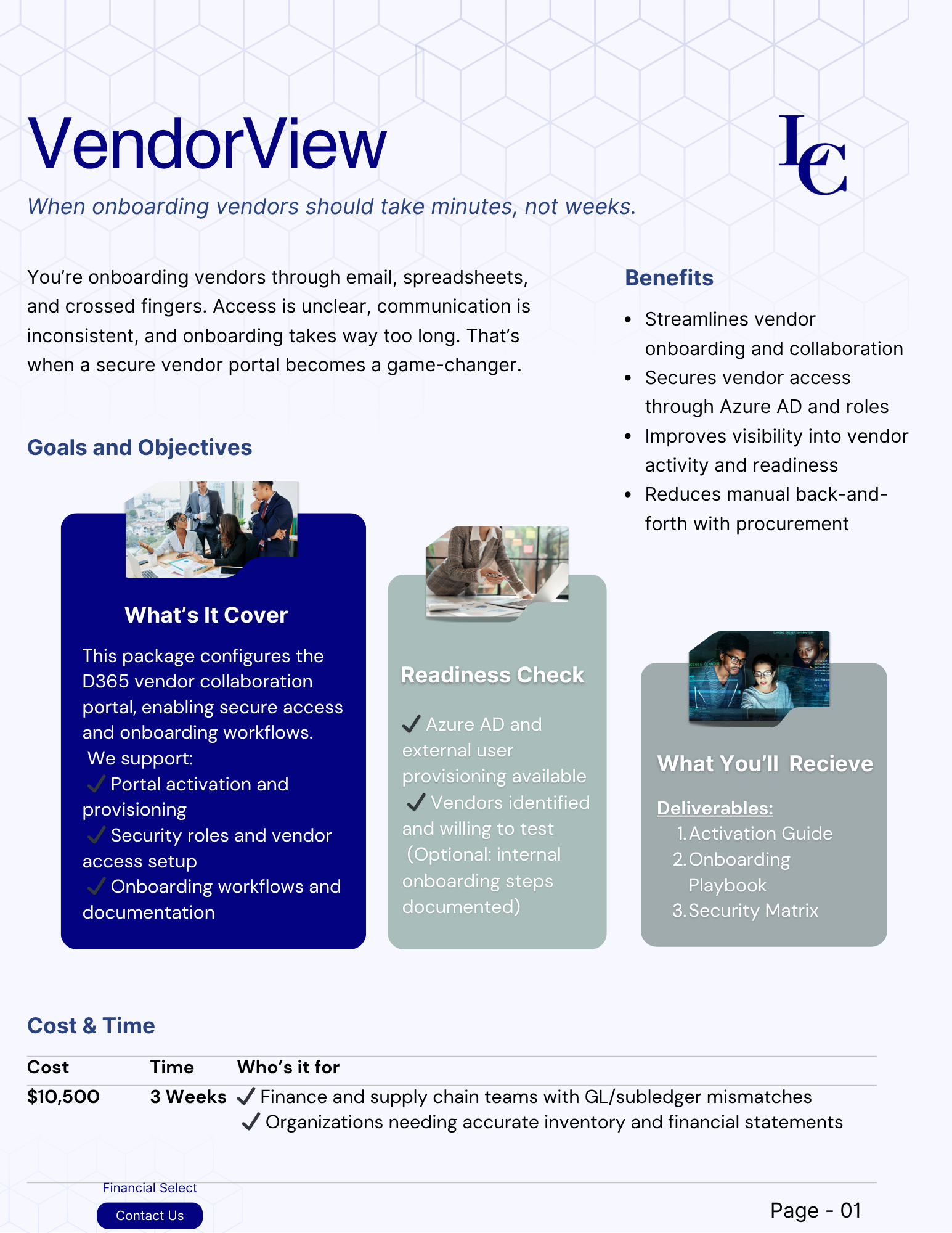



Reviews and corrects ledger-to-subledger alignment in D365 by fixing posting configurations, inventory profiles, reconciliation logic, GL mapping, and critical reporting procedures.
Business Central for Discrete Manufacturing: How Production Scheduling Works
Posted on: July 7, 2026 | By: Jackson Morris | Microsoft Dynamics Business Central
A single missed component or overbooked machine can push a delivery date back days, and the ripple effects don’t stop there. For companies still coordinating production through spreadsheets or disconnected systems, this kind of disruption is a routine cost of doing business. Microsoft Dynamics 365 Business Central approaches this differently, building production scheduling directly into the same system that manages inventory, purchasing, and finance, so planners are working from one connected view rather than reconciling data across tools.

What is Production Scheduling in Business Central?
Production scheduling in Business Central is the process of translating demand, whether from sales orders or forecasts, into a realistic sequence of manufacturing operations. The system does this by combining a few core building blocks: work centers and machine centers that represent your physical production resources, routings that define the steps required to build each item, and production orders that carry that plan through to execution on the shop floor.
Each work center and machine center in Business Central carries its own calendar, reflecting shift hours, holidays, and planned downtime, along with cost rates and efficiency factors. This means the schedule Business Central generates isn’t based on theoretical capacity. It reflects when a resource is actually available to run.
Why It Matters for Discrete Manufacturers
Discrete manufacturers build distinct, countable units like machinery, electronics, or industrial equipment. That work usually comes with multi-level bills of materials, frequent engineering changes, and a mix of make-to-stock and make-to-order demand. That complexity makes scheduling harder than it looks. A single finished item might depend on a dozen components, each with its own lead time, and a delay in any one of them can stall an entire production run.
Because Business Central ties routings, work centers, and inventory together in a single system, a change in one area, a delayed component or an unexpected downtime, shows up immediately in the production plan. Planners aren’t waiting for someone to manually update a separate scheduling tool. The schedule reflects the current state of the business.
Key Capabilities: Work Centers, Machine Centers, and Capacity Planning
Business Central lets manufacturers model production at two levels of detail. Work centers represent broader groupings of resources, such as a department or a labor pool, while machine centers represent individual pieces of equipment within that work center. For most mid-market discrete manufacturers, this two-level structure provides enough granularity to schedule accurately without overwhelming planners with unnecessary detail.
The system supports both infinite and finite capacity scheduling. Infinite scheduling assumes a work center can absorb any workload, which is useful for rough-cut, high-level planning. Finite scheduling respects the actual capacity limits of a resource and pushes operations forward in time when that resource is already booked. For day-to-day planning, finite scheduling gives a much more realistic picture of when an order can actually be completed.
MRP, MPS, and the Production Order Lifecycle
Business Central’s planning engine ties demand directly to production. Material Requirements Planning reviews sales orders, forecasts, safety stock levels, and existing supply, then proposes what needs to be purchased and what needs to be produced. Master Production Scheduling works at a higher level, aligning overall production volumes with capacity and demand trends. Together, they remove much of the manual reconciliation that otherwise falls on a planner’s shoulders.
Once a plan is approved, it moves through a defined production order lifecycle: simulated for early planning, planned and firm planned as the order is confirmed, released to the shop floor for execution, and finally finished once output is complete and costs are posted. This lifecycle gives manufacturers a clear, auditable path from initial plan to finished goods, with material consumption, labor, and cost variances tracked at every stage.
Preparing for Growth: When to Extend Native Scheduling
For most mid-market discrete manufacturers, Business Central’s native scheduling tools cover the essential planning loop well. As operations grow more complex, though, some manufacturers reach a point where they need constraint-based scheduling, automatic load leveling, or scenario modeling that goes beyond what’s available out of the box. Business Central’s extensibility, through Microsoft AppSource and its broader partner ecosystem, means these more advanced scheduling capabilities can be layered on without replacing the core system.
The right approach depends on where a manufacturer is in their growth. A company running a handful of work centers with fairly stable routings may never need more than native functionality. A manufacturer juggling multiple shifts, frequent engineering changes, and tight delivery windows may find that added scheduling depth pays for itself quickly.
Next Steps
Production scheduling is one of the areas where Business Central delivers the clearest, most immediate value for discrete manufacturers. Logan Consulting helps manufacturers configure work centers, routings, and capacity planning so the schedule Business Central generates actually reflects how the shop floor runs. Contact Logan Consulting to evaluate your production scheduling setup and identify where Business Central can tighten up your planning process.