

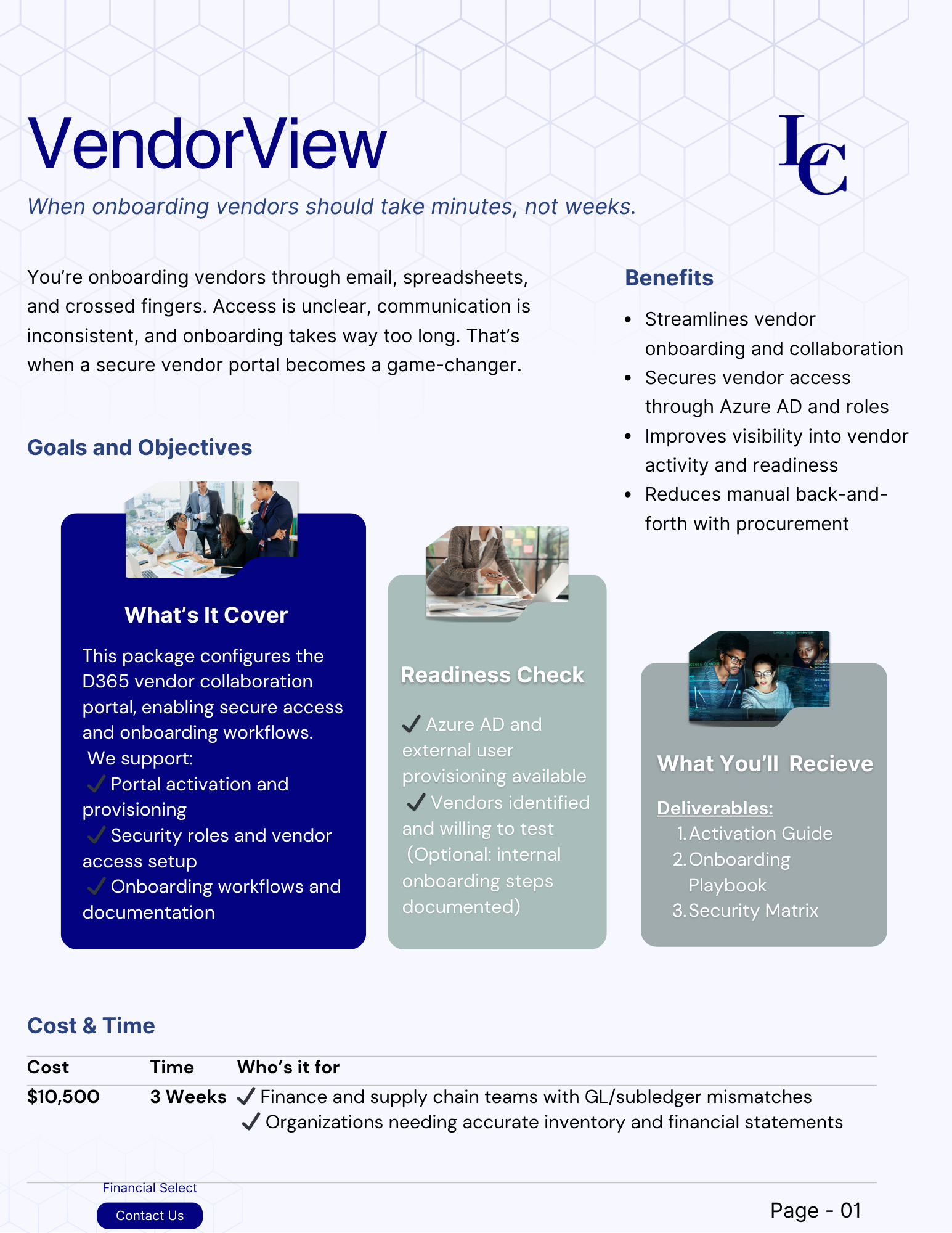


Reviews and corrects ledger-to-subledger alignment in D365 by fixing posting configurations, inventory profiles, reconciliation logic, GL mapping, and critical reporting procedures.
Tag: Finance and Operations
Join Logan Consulting at DynamicsCon 2026
Posted on: April 1, 2026 | By: Ashley Xue | Microsoft Dynamics AX/365
Logan Consulting is excited to return to DynamicsCon 2026 as an Advocate Sponsor, bringing our expertise and insights back to one of the most influential gatherings in the Microsoft Dynamics community. DynamicsCon brings together users, partners, and industry leaders for several days of learning, collaboration, and innovation across the Microsoft Dynamics 365 ecosystem. We invite you to visit Booth #435 to connect with our team and explore how organizations are...
Accounts Receivable in D365 the Age of Digital Finance
Posted on: March 30, 2026 | By: Ashley Xue | Microsoft Dynamics AX/365
Most organizations think about Accounts Receivable when invoices are past due and cash is late. But Modern AR is not just about collecting payments, it’s one of the clearest operational signals a company has because it reveals customer health, pricing discipline, process maturity, and financial risk in real time. In Dynamics 365 Finance and Operations, Accounts Receivable is an operational system that connects sales, credit, billing, and cash application into a...
Managing Expenses in Dynamics 365
Posted on: March 19, 2026 | By: Ashley Xue | Microsoft Dynamics AX/365
Microsoft Dynamics 365 streamlines and automates the expense management processes for all businesses through the Expense Management Module. Expense Management includes functionalities to support the entire expense management lifecycle, from expense submission to reimbursement, helping increase efficiency through approval workflows, and ensuring compliance with financial policies and regulations by flagging out of policy expenses. Expense Submissions Made Simple Employees can navigate to Expense Management > My Expenses > Expense Reports...
From Forecast to Fire Drill: Why Demand Planning Fails Without Governance
Posted on: March 25, 2026 | By: Ashley Xue | Microsoft Dynamics AX/365
Demand forecasts rarely fail because someone chose the wrong algorithm. They fail because too many organizations still treat the forecast as a number to admire, challenge, or casually overwrite, rather than an operational signal to govern. That distinction matters more now than it used to. Microsoft’s current Demand planning app in Dynamics 365 Supply Chain Management is explicitly built as a collaborative planning layer: no-code forecast modeling, on-the-fly aggregation and...
Improving Retail Inventory Traceability and Accuracy
Posted on: March 16, 2026 | By: Ashley Xue | Microsoft Dynamics AX/365
Retailers do not have a visibility shortage. They have a traceability standard shortage. With Dynamics 365 Commerce and Microsoft’s Inventory Visibility service, teams can view on-hand stock across stores and warehouses, check available-to-promise quantities, and support workflows like pickup in store and ship from store. That is useful. It is also why the harder question now matters more: not where is it, but what happened to it on the way...
Fixed Assets in the Age of ESG, Remote Audits, and Digital Finance
Posted on: March 9, 2026 | By: Ashley Xue | Microsoft Dynamics AX/365
Most companies can tell you how many fixed assets they own. Fewer can quickly tell you which book they sit in, how they were depreciated, when they were reclassified, or what happened when they were disposed. That is not a data shortage. It is a governance shortage. In D365 Finance, fixed asset reporting quality is shaped upstream by fixed asset groups, books, depreciation profiles, posting profiles, and capitalization policy. Microsoft’s...
Product Tracking Isn’t a Visibility Problem. It’s a Process Problem.
Posted on: March 5, 2026 | By: Ashley Xue | Microsoft Dynamics AX/365
Most organizations think they have a visibility problem. Usually, they have a process problem wearing a visibility costume. Products already leave a trail through receiving, warehouse work, production, and shipment. In Dynamics 365 Supply Chain Management, item tracing is based on historical inventory transactions plus a tracking dimension such as a batch, serial, or vendor batch number. From there, users can trace backward to the source and forward through production...
Financial Reporting in D365 Finance: Turning Data Structure into Decision Power
Posted on: March 3, 2026 | By: Ashley Xue | Microsoft Dynamics AX/365
Most finance teams do not have a data problem. They have a structure problem. There is usually no shortage of numbers. There is, however, often a generous surplus of conflicting dimension values, spreadsheet-side “fixes,” and month-end rituals that feel less like accounting and more like archaeology. In D365 Finance, financial dimensions are part of the ledger account structure, account structures define what combinations are valid at posting, and default dimension...
Regulatory Compliance in D365 Finance & Supply Chain: From Risk to Control
Posted on: February 25, 2026 | By: Ashley Xue | Microsoft Dynamics AX/365
Industrial and manufacturing organizations operate in a regulatory minefield. Indirect tax (sales tax, VAT, GST), SOX-style internal controls, cross-border trade rules, hazardous materials documentation, sustainability reporting, pick your flavor. The fun part is that “small” gaps rarely stay small. They turn into fines, delayed shipments, audit findings, and that special kind of meeting where everyone suddenly remembers they had “concerns for a while.” Microsoft Dynamics 365 Finance and Supply Chain...
Order Fulfillment in Industrials: Where Complexity Either Gets Controlled or Multiplied
Posted on: February 23, 2026 | By: Ashley Xue | Microsoft Dynamics AX/365
In industrial organizations, order fulfillment isn’t a single handoff. It’s a chain reaction. Configured products. Long lead times. Partial shipments. Backorders. Engineering changes. Drop-ship orders. Intercompany fulfillment. Warehouse waves. Carrier appointments. And the occasional “we definitely have it… somewhere.” Every step introduces risk—and every missed handoff shows up later as margin erosion, late revenue, invoice disputes, or a customer escalation that begins with: “Just checking in…” (Spoiler alert: they were...