



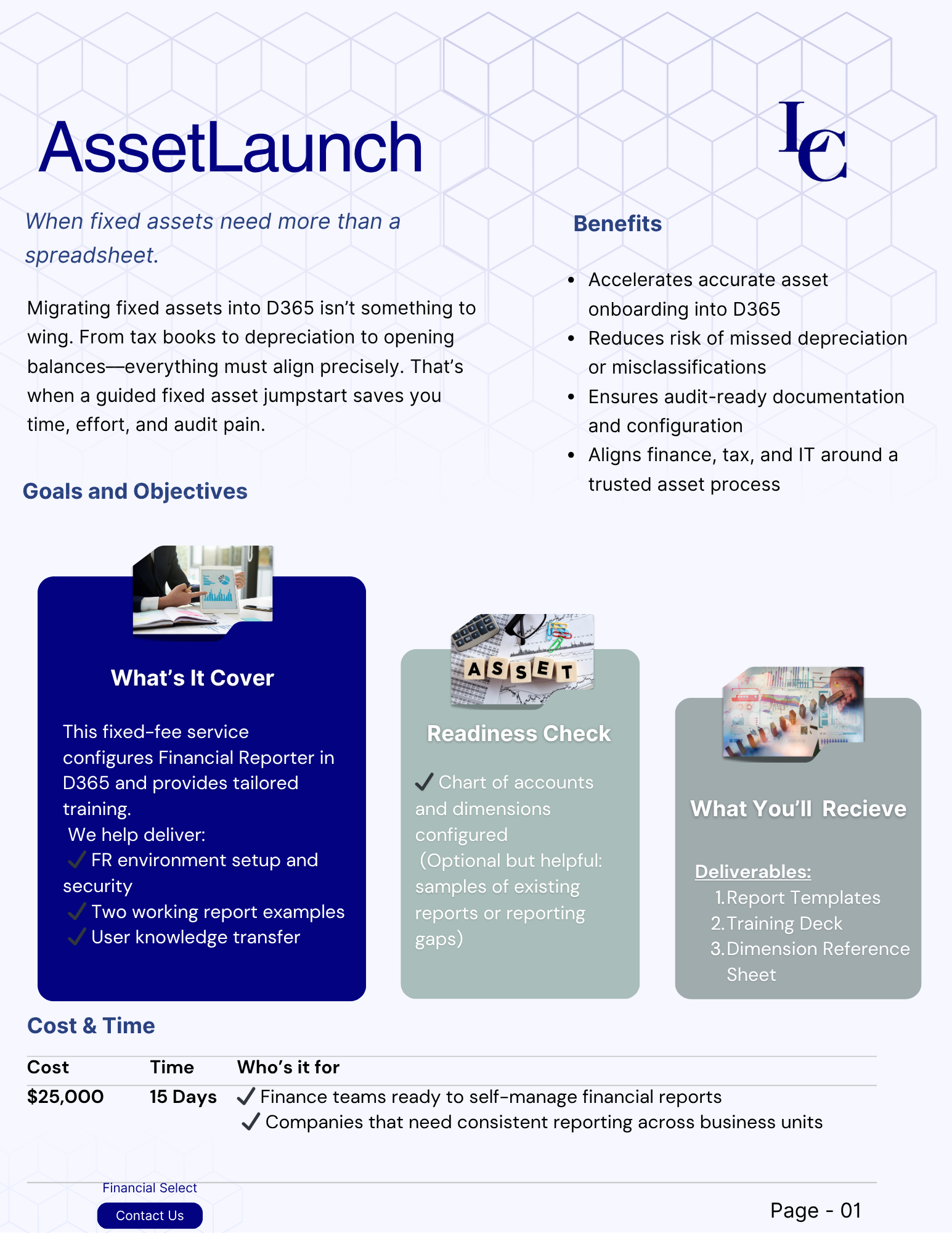
Reviews and corrects ledger-to-subledger alignment in D365 by fixing posting configurations, inventory profiles, reconciliation logic, GL mapping, and critical reporting procedures.
From Forecast to Fire Drill: Why Demand Planning Fails Without Governance
Posted on: March 25, 2026 | By: Ashley Xue | Microsoft Dynamics AX/365
Demand forecasts rarely fail because someone chose the wrong algorithm. They fail because too many organizations still treat the forecast as a number to admire, challenge, or casually overwrite, rather than an operational signal to govern.
That distinction matters more now than it used to. Microsoft’s current Demand planning app in Dynamics 365 Supply Chain Management is explicitly built as a collaborative planning layer: no-code forecast modeling, on-the-fly aggregation and disaggregation, version history, in-product commenting, Microsoft Teams collaboration, and native integration back to Supply Chain Management. The tooling is no longer the weakest link. In most cases, the weaker link is ownership—who can change the forecast, when, and with what downstream consequence.

Forecast accuracy is not forecast discipline
This is the first trap. Many companies measure forecast accuracy and assume they are measuring planning maturity. They are not.
D365 can absolutely help quantify forecast performance. In the legacy demand-forecasting stack, Supply Chain Management calculates both historical forecast accuracy and model-estimated accuracy, including MAPE. In the newer Demand planning app, forecast profiles keep job history, identify who ran the profile, preserve or overwrite versions of a time series, and expose “Explainability” details showing which algorithm was used for each dimensional combination and what MAPE it produced. That is valuable. But a forecast can be statistically respectable and still be operationally unruly if changes are made without discipline. Bad governance can turn even a good forecast into a nicely formatted guess.
Where governance actually breaks
The break usually happens in the gap between planning and permission.
Microsoft’s own demand-forecasting process guidance says the forecast is generated, reviewed, updated by users as needed, and then authorized so it can be published to the system for planning and other operations. That is already a governance model in miniature: create, review, authorize, publish. Problems begin when organizations skip the middle verbs and go straight from “someone adjusted it” to “operations now has to live with it.” At that point, the forecast stops functioning as a governed input and starts behaving like a spreadsheet rumor with system access.
The cost of that looseness is not theoretical. Microsoft’s process guidance ties better demand forecasting to lower buffer inventory, fewer expedites, shorter fulfillment lead times, and fewer stockouts. In other words, when the planning signal is unreliable, organizations compensate in expensive ways: extra inventory, rush purchasing, nervous capacity decisions, and month-end explanations that sound suspiciously like apologies.
What governance looks like inside D365
The encouraging part is that D365 already contains the mechanics for much tighter control.
Demand planning includes defined security roles in both Supply Chain Management and Power Platform. Microsoft documents out-of-box roles such as Production planner, Sales manager, and Production manager on the SCM side, plus Demand Planning Contributor and Demand Planning Manager on the Power Platform side. Contributors are controlled by row-level access and can edit only the data they have access to; they can also collaborate through Microsoft Teams and in-app comments. That means ownership does not have to be a hallway conversation. It can be encoded into the product.
The worksheet model reinforces that discipline. Demand planning lets teams create shared or private worksheets, overlay time series for comparison, filter by dimensions, add cell-level comments, and work with multiple versions of planning data. In other words, the system is built to support controlled debate—not silent edits. You can compare a baseline to an adjusted scenario without losing the lineage of either one, which is a far more civilized way to argue about demand than sending around “Forecast_Final_v12.”
The controls that prevent “just one quick change”
This is where governance stops being abstract and becomes practical.
Time fences let demand planning managers prevent manual edits to selected values for a defined horizon. Microsoft notes that these fences can be built using dimensions such as product or location, and can even vary by role—so one user may be allowed to edit a period that another user cannot. Time freezes solve the opposite problem: they prevent forecast recalculation from automatically overwriting selected values in existing time series. D365 also supports a simpler freeze option that preserves all manual adjustments when a forecast is recalculated, so rolling forecasts do not casually erase human judgment. These controls do not make planning slower; they make last-minute changes deliberate.
Why governance matters only if execution listens
A forecast becomes consequential when the rest of the planning engine is allowed to consume it.
In master planning, D365 can include a demand forecast in a master plan, apply a forecast model, use a method to reduce forecast requirements, and apply a forecast-plan time fence. That is the handoff from planning conversation to supply signal. If the forecast that reaches that point is unmanaged, then procurement, production, distribution, and inventory all inherit the disorder. If the forecast is governed, those downstream calculations are at least reacting to an agreed-upon assumption rather than a moving target.
Governance is what makes agility believable
There is a persistent myth that governance means bureaucracy. In practice, the opposite is usually true.
D365 Demand planning supports scheduled profile runs, versioned outputs, scenario comparison, and Copilot-based analysis of selected periods in natural language across multiple dimensions. The point of governance is not to suppress change. It is to make change attributable, reviewable, and reversible. Agility is not the freedom for everyone to touch the forecast. It is the ability to know which version is authoritative, why it changed, and what will happen when it is published.
Final thought
Forecasting will never eliminate uncertainty. Markets change. Promotions disappoint. Customers behave with a level of creativity that planners would prefer they reserve for other areas of life.
But uncertainty is not the same thing as disorder. D365 already gives organizations the architecture for more disciplined demand planning: role-based access, row-level controls, shared worksheets, comments, versions, time fences, time freezes, scheduled forecast profiles, explainability, and the ability to authorize and publish a forecast for planning. The real differentiator is whether the organization chooses to govern the forecast as an operational commitment rather than treat it as a periodically updated opinion.
When that discipline is present, forecasts stop triggering fire drills. They start doing the quieter, more valuable work of making the supply chain predictable.