

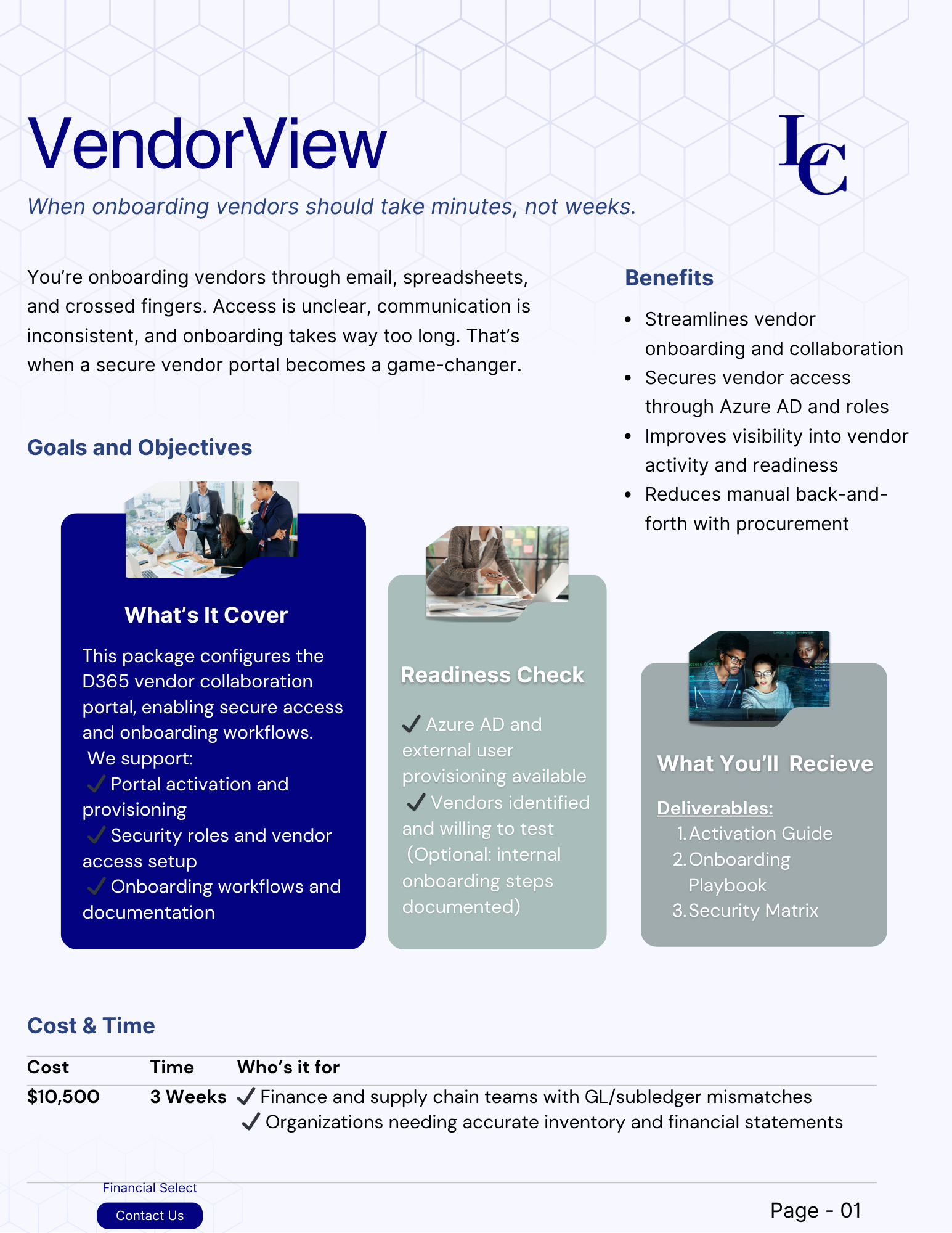


Reviews and corrects ledger-to-subledger alignment in D365 by fixing posting configurations, inventory profiles, reconciliation logic, GL mapping, and critical reporting procedures.
Category: QAD Distribution
ERP Go-Live Data Reconciliation and Approval Process Using SharePoint
Posted on: June 1, 2018 | By: Tim Lovely | QAD Financials, QAD Manufacturing, QAD Business Process, QAD Distribution
In prior articles Logan Consulting has discussed its pervasive use of SharePoint to function as a repository for all project documents and to help manage and execute Logan Consulting’s ERP Implementation Methodology. This post focuses on using SharePoint to manage and store all approvals for the final cutover weekend conversion of dynamic data such as open Accounts Payable, open Accounts Receivable, open Sales Orders, open Purchase Orders, on hand Inventory,...
Master Data Audits and Approvals Prior to Cutover Critical to Success of Dynamic Data Conversion
Posted on: May 30, 2018 | By: Tim Lovely | QAD Distribution, QAD Financials, QAD Manufacturing, QAD Business Process
Cutover weekends for large ERP implementations are often stressful events. Detailed cutover checklists must be developed in advance with all system and non-system tasks documented for completion by specific date and time with assigned owner. One of the most important tasks over a cutover weekend relate to the conversion of dynamic data such as open Accounts Payable, open Accounts Receivable, open Sales Orders, open Purchase Orders, on hand Inventory, and...
Focus on Technical and Equipment Testing at Cutover
Posted on: May 28, 2018 | By: Tim Lovely | QAD Financials, QAD Manufacturing, QAD Business Process, QAD Distribution
As we wrote about in prior articles, cutover weekends for large ERP implementations are often focused on executing a pre-defined cutover checklist, mostly focused on conversion of dynamic data such as open Accounts Payable, Accounts Receivable, open Sales Orders, open Purchase Orders, Inventory, and open Work Orders. In addition to data related tasks, it is critical to test the use of all equipment prior to cutover to confirm the equipment...
“License Plate” tracking with QAD Serialization
Posted on: March 28, 2018 | By: Andrew Hall | QAD Manufacturing, QAD Distribution
If you are need of license plate tracking (LPN) of containers, pallets, reels, etc., the latest offerings from QAD offer Serialization, which allows for the transaction of a defined container using a single license plate number. This replaces the traditional need to always enter Item Number, Quantity, and Lot/Serial Number on all inventory related transactions. This speeds transaction time and also eliminates the multiple points of error in the transaction....
What not to do with Comments, and how Item Attributes can help
Posted on: March 27, 2018 | By: Andrew Hall | QAD Manufacturing, QAD Business Process, QAD Distribution
One of the challenges that I have seen over the years is converting a client to QAD when they are coming from an environment that is not accustomed to driving production planning and execution through strict adherence to Item Numbers, Product Structures and Routings that are based on form-fit-and function (FFF). Instead, these clients often drive business behavior through extensive use of comments. Though this approach can work when a...
Logan Consulting Process Flow and Narrative Approach
Posted on: March 23, 2018 | By: Tim Lovely | QAD Practice News, QAD Manufacturing, QAD Distribution, QAD Financials
At the recent QAD Midwest Users Group Conference (MWUG) in Lombard, IL; Darrell Finney of Fintek Consulting re-enforced to the keynote speaker audience the need to bridge the communication gap between IT and the business. He reviewed useful tools such as SIPOC’s and Swim Lane Process Flow Mapping, among others. Logan Consulting has stressed the value of the Swim Lane Process Mapping approach for years, as it is a very...
Logan Consulting Presentation Summary of QAD Midwest User Group
Posted on: March 22, 2018 | By: Tim Lovely | QAD Financials, QAD Practice News, QAD Manufacturing, QAD Business Process, QAD Distribution
After a great Keynote Address by Darrell Finney of Fintek Consulting, Logan Consulting and other MWUG attendees focused on presentations on new QAD functionality and pertinent QAD related topics. James Blankenship presented on EE Financial Customizations. The session was a 'How To', focusing on how to use the financial API’s in EE to add custom fields, add validation to a field, and how to extract/query data from financial tables. Andy...
QAD Midwest User Group Foundational Functional Training
Posted on: March 21, 2018 | By: Tim Lovely | QAD Business Process, QAD Distribution, QAD Financials, QAD Practice News, QAD Manufacturing
For the past several years, Logan Consulting has provided functional training immediately following the conference at the conference venue. The goal of the training is to develop an understanding of the fundamental business concepts related to manufacturing, how these concepts relate to ERP, and specifically how they are handled within QAD Enterprise Applications. The sessions will first focus on general business processes (e.g. Master Scheduling) to ensure all participants understand...
Acquisition Integration Approach Considerations for QAD EE
Posted on: March 20, 2018 | By: Tim Lovely | QAD Financials, QAD Manufacturing, QAD Business Process, QAD Distribution
As companies that use QAD’s Enterprise Applications grow through acquisitions, they need to answer a number of questions on how they will integrate the new acquisition into their QAD EE environment. QAD EE provides a high level architecture of one or more Domains within a physical Database. Within a domain, multiple financial entities with one or more site per entity can be levered. At a high level, different types of...
Proper Training is critical to the short and long-term success of your QAD implementation
Posted on: March 14, 2018 | By: Andrew Hall | Professional Services, QAD Financials, QAD Manufacturing, QAD Business Process, QAD Distribution
All ERP implementations are impacted by multiple factors that ultimately determine whether the implementation is a success. When viewed in the short-term (i.e. from software selection to actual “go-live”) and long-term (go-live through system maturity), one of the biggest factors is training. And, unfortunately, this is the factor that often receives the least attention after the go-live date. The result of the long-term is that users are no longer following...