


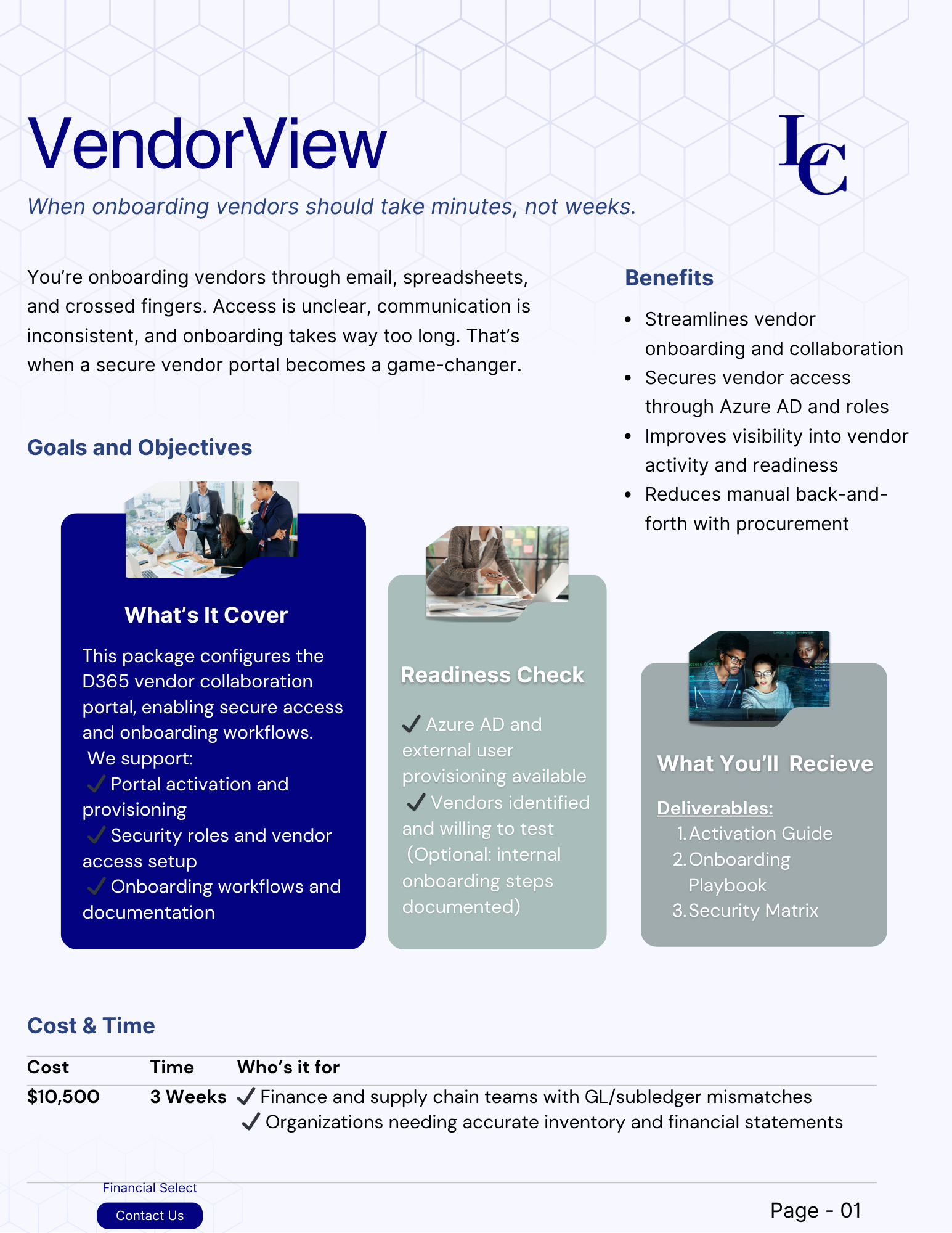


Reviews and corrects ledger-to-subledger alignment in D365 by fixing posting configurations, inventory profiles, reconciliation logic, GL mapping, and critical reporting procedures.
AI-Powered Demand Planning in Dynamics 365: From Forecast Guesswork to Forecast Intelligence
Posted on: June 22, 2026 | By: Heather Zhu | Microsoft Dynamics AX/365, Microsoft Dynamics AX/365|Microsoft Dynamics Manufacturing
Demand planning has always had one unforgiving truth: the forecast is only useful if people trust it.
For years, supply chain teams have been asked to predict demand in markets that refuse to behave politely. Customer behavior shifts. Promotions overperform or flop. Weather happens. Inflation moves. Suppliers miss dates. Sales teams change assumptions.
Then the demand planner gets asked why the forecast changed, usually five minutes before a meeting that has “alignment” in the title.
Traditional forecasting tools were built to produce a number. Modern planning teams need more than that. They need to understand why the number changed, what influenced it, whether it can be trusted, and what decision should come next.
That is where Microsoft’s Demand Planning capabilities in Dynamics 365 Supply Chain Management are becoming especially interesting.
Demand Planning is Microsoft’s next-generation collaborative planning solution, designed around no-code demand modeling, scenario comparison, aggregation and disaggregation, version history, in-product commenting, Microsoft Teams collaboration, and native integration with Supply Chain Management. Microsoft positions the application around intelligent forecasting, analytics, collaboration, and exception-based planning — not simply a better spreadsheet.
The Problem with Traditional Demand Planning
Most organizations do not struggle because they lack data. They struggle because their planning process turns data into debate.
Common challenges include disconnected spreadsheets, manual forecast overrides with limited visibility, inconsistent assumptions across regions or product groups, slow reactions to promotions or seasonality, and forecast changes that are visible but not easily explainable.
That last point matters. If a forecast suddenly jumps 18%, planners need to know whether the change came from historical demand, seasonality, signal inputs, model adjustments, or manual overrides.
Forecast accuracy is important. Forecast explainability is what creates trust.
What Changed with AI-Powered Demand Planning?
Microsoft’s 2025 Release Wave 1 introduced Demand Planning enhancements focused on Copilot-powered analysis, generative insights, cell-level explainability, and improved forecasting intelligence.
The direction is clear: organizations are moving from “generate a forecast” to “generate a forecast, explain the forecast, and help planners investigate the forecast.” That is a much better game.
Copilot Turns Planning Questions Into Faster Analysis
Copilot in Demand Planning allows users to select a point within a worksheet chart and ask predefined analytical questions, such as what changed period-over-period, what changed year-over-year, what trends occurred over the last six periods, whether there are significant outliers, or why one time series differs from another.
Copilot responds with natural-language explanations and visual analysis to help planners identify trends, anomalies, demand shifts, and forecast deviations.
This is not “AI predicts the future while everyone goes to lunch.” It is far more practical. Planners can investigate demand fluctuations in minutes instead of manually slicing data across products, locations, customers, and time periods. Because planning decisions age quickly — a useful insight on Monday can become trivia by Friday.
Cell-Level Explainability Reduces the Black-Box Problem
One of the most impactful additions is the Copilot Grid Cursor, which provides detailed insight into an individual forecast cell. For a selected forecast value, planners can review the original forecast value, manual adjustments, adjustment history, user comments, forecast breakdowns, and a timeline of changes. The Cell Analysis view includes an executive summary, breakdown visualization, and adjustment-history timeline.
One of the biggest barriers to AI adoption is not mathematics. It is trust. Planners need answers to questions like: what was the baseline forecast, what changed, was there signal impact, who made adjustments, why were adjustments made, and how did the forecast evolve into the final plan.
Microsoft has also enhanced the Copilot Grid Cursor to separate signal-input impact from baseline forecast values. That kind of transparency becomes critical when AI is influencing operational decisions.
If no one can explain the forecast, it is not a forecast. It is a number with confidence issues.
Generative Insights Make Seasonality Easier to Find
Seasonality is one of the most important and most difficult forecasting challenges. Seasonal behavior rarely looks the same across thousands of item-location combinations. A product may spike in one region, flatten in another, and behave completely differently somewhere else.
Microsoft’s Generative Insights capabilities automatically detect seasonality patterns and identify signal correlations. The system can cluster forecast patterns, assign confidence scores, explain trends in natural language, and highlight the percentage of planning items following each pattern.
Planners do not need AI to replace judgment. They need AI to surface patterns that would take too long to find manually. Instead of debating whether seasonality exists, teams can focus on deciding what to do about it.
Forecasting with Signals: Demand Is Bigger Than History
Historical demand matters, but history alone is a limited teacher. Demand Planning now supports forecasting with external signals that can influence demand outcomes, including inflation, weather, promotions, stockouts, pricing changes, and macroeconomic indicators.
Microsoft has expanded forecasting with signals using XGBoost models, allowing planners to incorporate multiple signal inputs simultaneously.
Real-world demand is influenced by more than last year’s shipments. A forecast that ignores external drivers may still look mathematically sound — it just may be mathematically wrong.
AI Does Not Eliminate Governance
AI-powered demand planning improves planning only when data and processes are disciplined. Demand Planning still depends on importing data, transforming data into time series, creating forecasts, reviewing forecasts, making adjustments, and exporting plans for execution.
The technology can explain a forecast, detect seasonality, and surface signal correlations. But it cannot fix poor master data, correct disconnected planning processes, resolve organizational disagreements, or replace governance. The technology is only as effective as the process surrounding it.
What Supply Chain Leaders Should Take Away
The value of Copilot and Generative Insights is not that planners stop thinking. The value is that planners spend less time hunting and more time deciding.
AI-powered Demand Planning can help organizations investigate forecast changes faster, build trust through explainability, identify seasonality patterns, incorporate external signals, reduce manual analysis, and improve collaboration across sales, operations, and finance.
Microsoft continues to invest in this area, including generative insight enhancements, faster forecast calculations, best-fit model improvements, intermittent-demand forecasting, and expanded forecast-with-signals capabilities. This is not a one-time feature release — it is an evolving planning platform.
How Logan Consulting Can Help
Turning on a feature is not the same thing as improving planning maturity. Organizations need to answer important questions first: Are historical demand inputs clean and complete? Which signals actually improve forecast quality? Who can adjust forecasts? How are adjustments documented? How does planning connect to execution? What metrics define success?
Success metrics vary by organization but typically include forecast accuracy, inventory turns, stockout reduction, service levels, and planner productivity.
At Logan Consulting, we help manufacturers, distributors, and supply chain organizations design the process around the technology — not the other way around. Dynamics 365 can provide the AI, forecasting models, and planning workspace. The business still needs governance, ownership, and adoption. That is usually where the real improvement happens.
Final Thought
AI-powered demand planning is not about replacing planners. It is about making planning less mysterious. Copilot helps planners ask better questions faster. Cell-level explainability helps teams understand why a number changed. Generative insights surface seasonality and signal patterns that might otherwise remain buried in the data. Forecasting with signals helps demand plans reflect the real world — not just historical transactions.
The biggest shift is not from manual to automated. It is from forecast output to forecast intelligence. Because in supply chain planning, the winning team is not always the one with the most sophisticated model. It is the one that understands the forecast soon enough to do something useful with it.