


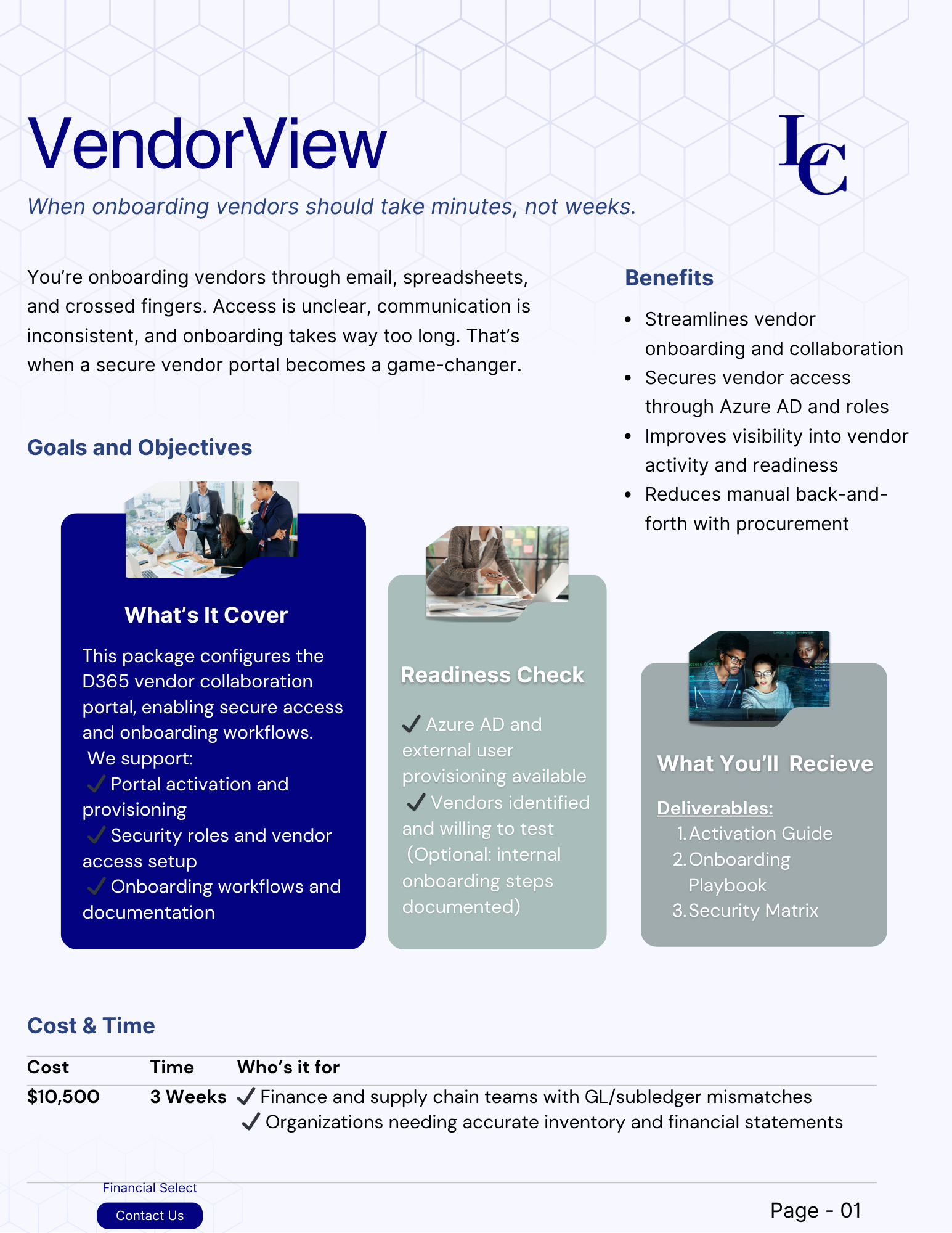


Reviews and corrects ledger-to-subledger alignment in D365 by fixing posting configurations, inventory profiles, reconciliation logic, GL mapping, and critical reporting procedures.
Financial Reporting in D365 Finance: Turning Data Structure into Decision Power
Posted on: March 3, 2026 | By: Ashley Xue | Microsoft Dynamics AX/365
Most finance teams do not have a data problem. They have a structure problem.
There is usually no shortage of numbers. There is, however, often a generous surplus of conflicting dimension values, spreadsheet-side “fixes,” and month-end rituals that feel less like accounting and more like archaeology. In D365 Finance, financial dimensions are part of the ledger account structure, account structures define what combinations are valid at posting, and default dimension values can come from master data, document headers, and main accounts. In other words, reporting quality is usually decided much earlier than the CFO review meeting.
That is the part many organizations underestimate. Microsoft gives you the tools: financial dimensions, account structures, advanced rules, trial balance by dimension, and Financial reporting with in-application viewing and report design. But the platform does not magically convert inconsistent transaction design into executive clarity. Excel is still a useful tool. It is a terrible governance model.
Why reporting still gets messy
Across industries, the reporting pain points look suspiciously similar: multiple versions of margin, manual consolidations, long close cycles, and leadership teams waiting for someone to “tie out one more tab.” The issue usually is not the report at the end. It is the way the transaction was tagged at the beginning.
D365 Finance is built to let organizations categorize transactions beyond the main account using financial dimensions, and Microsoft explicitly notes those dimensions can be used for analysis such as a profit and loss statement by dimension or a trial balance by dimension. That is powerful. It is also unforgiving. If one business unit calls something “Plant East,” another calls it “East Plant,” and a third decides “Ops-East” feels more expressive, reporting stops being automated and starts becoming interpretive dance.
Why dimensions matter more than people think
Account structures in D365 Finance use the main account and financial dimensions to define the order of entry and the valid values users can post. Microsoft’s current guidance is blunt: you can use up to 11 segments in an account structure, but if you think you need more, step back and ask whether some of that logic should be handled through hierarchies, advanced rules, or a user-defined field instead. That is not Microsoft being difficult. That is Microsoft trying to save you from building a chart of accounts that behaves like a junk drawer with a login screen.
Logan POV: the best dimension strategy is not the one with the most granularity. It is the one leadership will still trust in 18 months.
A good rule of thumb is simple: use dimensions for repeatable reporting logic, not for one-off trivia. Microsoft specifically warns against using dimensions for non-reusable values such as document numbers or reference numbers, because it explodes the chart of accounts and hurts performance around close, revaluation, and consolidation. For those kinds of highly variable identifiers, financial tags are usually the better fit. Tags are flexible, but dimensions are the structured, validated reporting backbone.
The real unlock: standardization plus defaulting
This is where D365 Finance becomes useful instead of merely impressive in demos.
Default dimensions can come from master records, document headers, and the main account, and Microsoft also supports derived dimensions so one dimension can automatically populate another. For example, a cost center can drive a department value by default. That matters because the fastest close is not the one with the most heroic cleanup. It is the one where cleanup never had to happen in the first place.
That is also why governance matters. D365 supports custom and entity-backed dimensions, legal-entity overrides, and uniqueness requirements for dimension values. So the system gives you the mechanics for control, but finance still needs to own the standards: naming, creation rights, retirement rules, and periodic cleanup. Otherwise “financial insight” turns into “financial storytelling,” and that genre gets dangerous fast.
Reporting is only as good as the structure underneath it
When the structure is sound, D365 Finance gives teams a lot of reporting leverage without forcing everything through offline spreadsheets.
Financial reporting in D365 is available through an add-in, includes in-application viewing plus a click-once report designer, and supports security-based access for design, generation, and review. Microsoft’s own walkthroughs show users drilling from a financial report into account detail, then into report transaction level and voucher transactions, applying dimension filters such as Business Unit, and using reporting trees or organization hierarchies for divisional and consolidated reporting. Financial reporting also ships with 22 default reports, which is a polite Microsoft way of saying, “you probably have more starting material than you’re using.”
The trial balance side matters too. A financial dimension set is an ordered list of dimensions used to summarize general ledger data, primarily for trial balance. D365 can maintain balances for those dimension sets, force an update when the trial balance is opened, and under the newer performance enhancement, keep balances updated through background process automation that runs every five minutes by default. That is not “Wall Street ticker tape” real time, but it is current enough to support faster, more confident management reporting when the underlying dimensions are clean.
Why this matters across industries
The mechanics are the same even when the operating model changes.
Manufacturers want margin by plant, product family, or legal entity. Distributors want channel and customer profitability. Services firms want project-level clarity. Multi-entity organizations want consolidated statements without a monthly hostage negotiation between accounting teams. D365 Finance supports multi-company and multi-currency consolidation scenarios, including aggregation, elimination, minority interest, and different charts of accounts or fiscal periods when reporting is designed properly.
The payoff: faster close, better decisions, less drama
Standardized dimensions do not just make reports prettier. They make the close process more reliable.
D365’s Financial period close workspace can track closing processes across companies, areas, and people, but even the best workspace cannot save inconsistent transaction design. When dimensions are governed, defaulting is intentional, and reporting structures are aligned to actual decisions, finance spends less time reconciling and more time explaining what the numbers mean. Which, last time I checked, is the whole point.
Final thought
Technology does not modernize financial reporting by itself. Structure does.
D365 Finance has the reporting muscle. The differentiator is whether the organization treats financial dimensions as a controlled reporting architecture or as a convenient place to stash whatever seemed helpful at the time. When the model is standardized, governed, and tied to how the business actually makes decisions, finance gets something better than faster reports: it gets a system leadership can believe.