



Reviews and corrects ledger-to-subledger alignment in D365 by fixing posting configurations, inventory profiles, reconciliation logic, GL mapping, and critical reporting procedures.
Turning Compliance Into Capability with Dynamics 365
Posted on: April 6, 2026 | By: Ashley Xue | Microsoft Dynamics AX/365
For a long time, compliance lived in the margins of the business. It appeared during audit season, surfaced in frantic spreadsheet reconciliations, and then politely disappeared until the next regulatory scare. That model is fading fast. Microsoft now maintains an ongoing catalog of country- and region-specific regulatory updates for Dynamics 365 Finance, and its electronic invoicing service is explicitly designed for configurable, country-sensitive document exchange rather than one static, universal template. In other words, the rules are moving, and the old “we’ll sort it out at quarter-end” routine is becoming an expensive hobby.
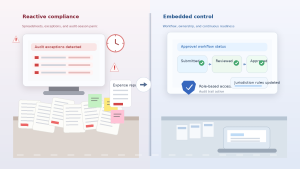
The more interesting shift is philosophical. Regulators increasingly care less about whether a report eventually looks tidy and more about how the transaction got there in the first place. That is why Microsoft’s compliance-related guidance in Dynamics 365 leans so heavily on role-based security, segregation of duties, workflow, and electronic signatures. The emphasis is not merely on producing clean outputs. It is on proving that the path to those outputs was controlled, attributable, and difficult to bypass.

Why compliance feels harder now
Part of the answer is that compliance has become operational, not just financial. In Dynamics 365, segregation of duties is defined at the duty and role level, workflows can enforce who reviews and approves what, and electronic signatures validate a user’s certificate and record that signature in an audit log. Those are not “reporting” features in the old sense. They are controls embedded in daily work. The best control, after all, is the one that runs before the mistake gets posted—not the one that writes a sad memo about it later.
Global operations make the picture messier. Tax rules are jurisdictional, localization updates keep changing, and digital reporting mandates are increasingly specific about formats, timing, and transmission. Microsoft’s Tax Calculation service is designed to automate tax determination and calculation with a configurable tax model, tax applicability matrix, and jurisdiction-level parameters, while Electronic reporting is built specifically to create and maintain regulatory electronic reporting and payments through configuration rather than custom code. Globalization Studio now sits over that stack as the workspace for services like Tax Calculation and electronic invoicing. That is a strong answer to regulatory volatility—assuming the organization wants a system more sophisticated than “ask Linda which VAT rule applies.”
And compliance is no longer confined to finance. In Supply Chain Management, Microsoft now documents advanced export management, country-of-origin tracking, and hazardous materials capabilities as part of product compliance. Country of origin lets organizations link products to origin and destination countries and track vendor certificates; hazardous materials features store dangerous-goods data and help prepare shipping documents through Warehouse management; advanced export management provides a dedicated configuration path inside SCM. Add the sustainability layer—where Microsoft Sustainability Manager can ingest custom dimensions tied to product or asset attributes—and you start to see why compliance has stopped being a side department and started becoming a data discipline.
What Dynamics 365 actually embeds
Where Dynamics 365 gets interesting is not that it “supports compliance.” Plenty of software claims that. The stronger claim is that it can embed governance into the transaction itself.
In Finance and Operations, role-based security is built around privileges, duties, and roles, and Microsoft explicitly notes that separating duties helps organizations comply with regulatory requirements such as SOX, IFRS, and FDA-related controls. The workflow system adds consistent routing, visibility, and centralized work lists. Approval processes can require a final approver, disallow submitters from approving their own documents, and even apply automatic actions when specific conditions are met. In other words, policy does not have to sit in a PDF no one reads. It can live in the workflow.
That same principle extends into sensitive master data. Vendor workflow and customer workflow can route proposed changes on selected fields for approval before those changes are applied. Vendor bank account workflow goes even further: protected fields can require approval on create or update, and the new bank account record is not available for use until approval is completed. That is a very practical form of compliance. It is also a wonderful way to keep “please update our bank details urgently” from becoming next week’s internal audit case study.
Continuous audit readiness, not ceremonial audit panic
This is the part most finance teams actually care about. The workflow history form lets users see the status, elapsed time, work items, and tracking details for submitted documents. Database logging can be configured at the table or field level and maintained through cleanup and consistency checks. Audit policies can evaluate expense reports, vendor invoices, and purchase orders against policy rules on a defined schedule. And electronic signatures log signed events for audit trail purposes. Put bluntly: the system can preserve much of the evidence trail while work is happening, which is a far better habit than reconstructing it from email archaeology later.
Why this becomes a business capability, not just a control function
The hidden advantage of embedded compliance is not merely risk reduction. It is operational confidence.
When finance trusts the approval chain, tax logic, and audit trail, fewer hours get burned reconciling “which version is correct.” When operations know export settings, origin records, and hazardous-material data are structured inside the system, fewer exceptions turn into emergency projects. When sustainability teams can connect reporting dimensions back to product or asset attributes, ESG stops being a separate spreadsheet religion and starts behaving like governed data. This is the quiet payoff of a well-architected platform: less heroic cleanup, fewer interpretive debates, and more time spent deciding what to do next.
That said, a useful reality check matters here. Microsoft is explicit in its hazardous materials documentation that the tools can help organizations record information and generate documents, but they do not automatically make an organization compliant with all applicable regulations. That warning is refreshingly honest and broadly instructive. Dynamics 365 can hardwire better behavior into operations. It cannot replace policy ownership, process design, or competent compliance leadership. Software is powerful. It is not absolution.
Final Thoughts
The organizations getting this right are not treating compliance as a periodic event. They are treating it as infrastructure.
That is the real shift. Compliance used to mean proving, after the fact, that the business behaved itself. Increasingly, it means designing systems where the compliant path is the default path, the auditable path, and ideally the easiest path. Dynamics 365 gives you a serious toolkit for that—security design, workflow governance, audit visibility, configurable tax and regulatory services, and supply-chain compliance controls that reach beyond finance. The differentiator is no longer whether the software can support compliance. It is whether the organization is willing to manage compliance as an operating capability rather than a quarterly panic ritual.
Next Steps
If you want more information on navigating the changes and impacts of Microsoft Dynamics 365 Supply Chain Management, contact us here. You can also email us at info@loganconsulting.com or call (312) 345-8817.