

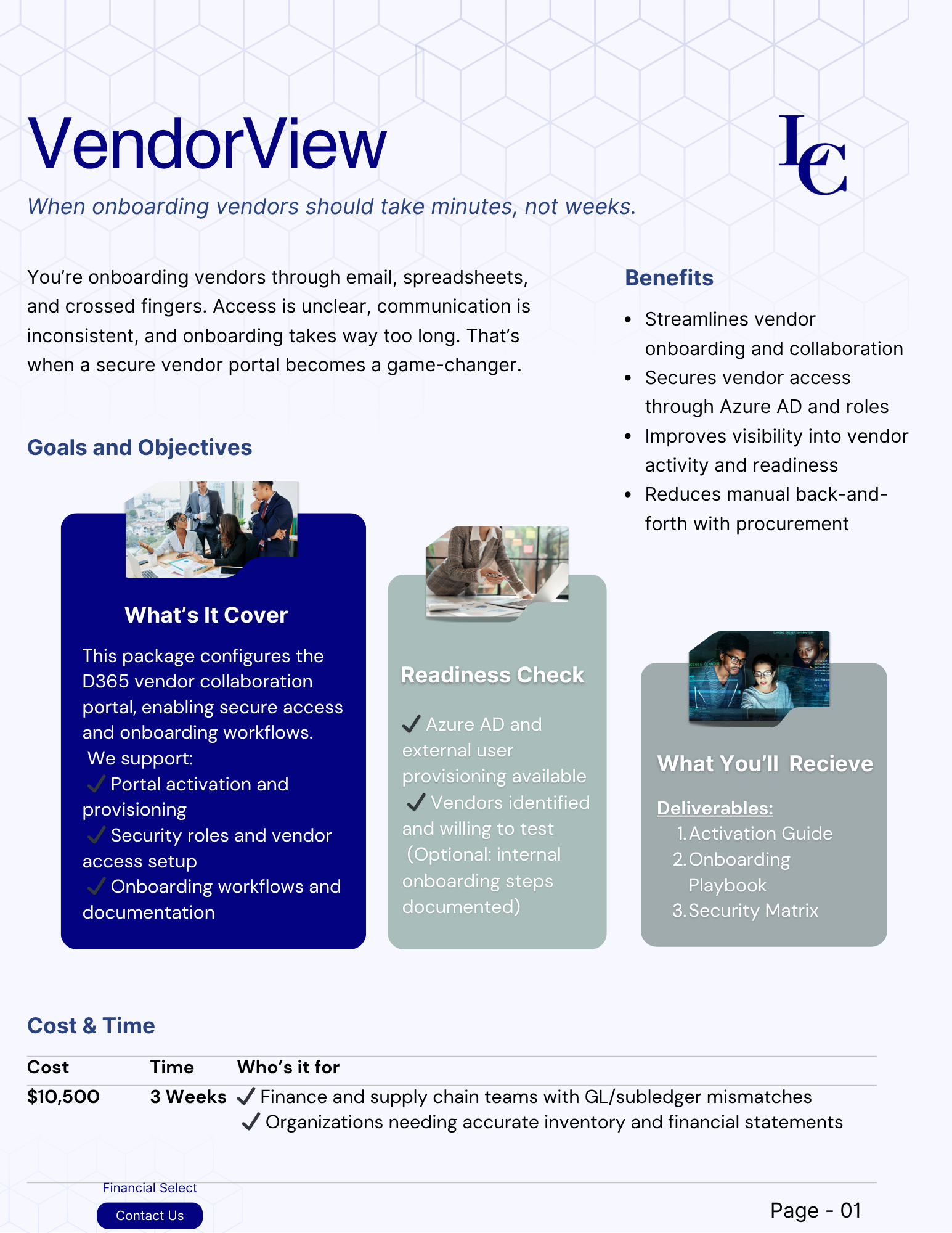


Reviews and corrects ledger-to-subledger alignment in D365 by fixing posting configurations, inventory profiles, reconciliation logic, GL mapping, and critical reporting procedures.
Optimizing Credit Management in Microsoft Dynamics 365 Finance and Supply Chain Management
Posted on: April 2, 2025 | By: Maya VanderWoude | Microsoft Dynamics AX/365, Microsoft Dynamics Manufacturing
For businesses that rely heavily on B2B sales, managing customer credit limits, terms, and risk factors is an essential process. With the advanced credit management functionality built into Microsoft Dynamics 365 Finance and Supply Chain Management (D365), organizations can create intelligent rules, automate decisions, and protect revenue—while still supporting customer relationships.
In this blog, we’ll explore the most practical use cases for implementing credit management in D365. We’ll also walk through how to configure key rules, workflows, and checkpoints that govern the credit process.

Why Use Credit Management in D365 Finance and Supply Chain?
Credit management in D365 allows businesses to:
- Establish clear, enforceable credit limits per customer
- Apply automated rules to block or release sales orders based on risk
- Support temporary credit increases for specific projects
- Centralize credit decisions at a corporate level
- Automate manual communication between finance, sales, and customer service
For organizations with large customer bases and variable order sizes, this functionality helps minimize financial exposure while maintaining efficient order processing.
Key Use Cases for Credit Management in D365
Let’s walk through some of the most impactful ways businesses can benefit from using D365’s credit management features.
1. Tracking and Maintaining Customer Credit Limits
With credit management enabled, D365 allows you to assign and monitor total credit limits for each customer. These limits are stored in the customer record under the credit and collections tab and can include:
- A credit limit expiration date to prompt annual reviews
- A last credit limit change date to track recent adjustments
- A centralized workflow to review and approve changes
This ensures no manual updates are made to limits without approval and helps prevent extending credit to dormant or high-risk customers. For a deep dive on credit management for financial health, read our previous blog post here.
2. Credit Limit Adjustments with Workflow
Adjusting credit limits in D365 is done through the credit limit adjustment form, which can handle:
- Permanent or temporary limit changes
- Automated increases based on historical data (optional)
- Filtering by customer, customer group, or other criteria
- Workflow-based approvals with audit trails
Once approved, the system automatically posts the updated credit limit to the customer record—no manual edits needed.
3. Using Credit Limit Expiration Dates to Reduce Risk
Expiration dates act as built-in safety measures. If a customer’s limit has expired and hasn’t been renewed, their sales orders can be automatically blocked until a new credit limit is approved.
This helps teams enforce regular credit reviews and ensures outdated credit lines don’t get used inadvertently.
4. Implementing Document Checkpoints for Credit Evaluation
D365 allows users to define when the system should evaluate a customer’s credit. These credit checkpoints can be set at key stages, such as:
- Order confirmation
- Release to warehouse
For companies with long lead times between order placement and fulfillment, this dual-check system ensures that credit conditions are verified again before goods ship out—even if the order was approved earlier.
5. Automatically Blocking Sales Orders Based on Rules
Credit management in D365 supports several standard rules to automatically block sales orders that pose a financial risk. Commonly used blocking rules include:
- Days overdue: Blocks customers with invoices overdue beyond a certain threshold (e.g., 30+ days)
- Overdue amount + credit usage: Combines total overdue balance and percent of credit limit used
- Terms of payment: Flags changes to payment terms that are more favorable to the customer
- Credit limit used: Blocks any order if the customer is over 100% of their credit limit
- Sales order amount: Triggers review if the sales order exceeds a certain value (e.g., $100,000)
- Credit limit expiration: Prevents orders if the credit limit has expired (with optional grace period)
By layering these rules, organizations can build robust credit strategies that balance customer flexibility with financial control.
6. Releasing Sales Orders—Manual and Automatic Options
When a sales order is blocked, D365 offers two main ways to release it:
- Manual release: A credit manager can review and manually release the order with or without posting.
- Evaluate for release: The system can automatically re-evaluate orders and release them once blocking conditions no longer apply (e.g., a payment was received).
This flexibility allows finance teams to control order flow while reducing administrative overhead.
Conclusion
Whether your business operates across multiple divisions, handles varying customer sizes, or simply wants better control over credit risk, Microsoft Dynamics 365 Finance and Supply Chain Management provides a powerful suite of credit management tools.
By configuring workflows, checkpoints, and automated rules, you can ensure consistent credit practices, reduce manual interventions, and support your customer relationships with confidence.
Next Steps:
If you are interested in learning more about credit management in Microsoft Dynamics 365 Finance and Supply Chain Management, contact us here to find out how we can help you grow your business. You can also email us at info@loganconsulting.com or call (312) 345-8817.
Related Posts
-
AI That Actually Works: Where Copilot Fits Inside Dynamics 365 Operations
Posted on: April 13, 2026
AI in enterprise software has developed a familiar stage routine. The demo is slick. The summary sounds brilliant. The assistant...
-
DynamicsCon 2026 Logan Consulting Speakers and Sessions
Posted on: April 8, 2026
Logan Consulting is proud to have several team members presenting at DynamicsCon in Las Vegas. These speakers bring deep expertise...