



Reviews and corrects ledger-to-subledger alignment in D365 by fixing posting configurations, inventory profiles, reconciliation logic, GL mapping, and critical reporting procedures.
Fixed Assets in the Age of ESG, Remote Audits, and Digital Finance
Posted on: March 9, 2026 | By: Ashley Xue | Microsoft Dynamics AX/365
Most companies can tell you how many fixed assets they own. Fewer can quickly tell you which book they sit in, how they were depreciated, when they were reclassified, or what happened when they were disposed. That is not a data shortage. It is a governance shortage.
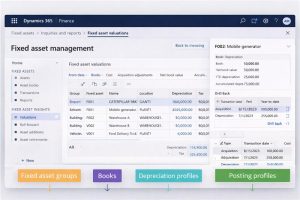
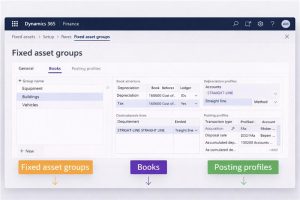
In D365 Finance, fixed asset reporting quality is shaped upstream by fixed asset groups, books, depreciation profiles, posting profiles, and capitalization policy. Microsoft’s setup guidance is pretty clear: fixed asset groups define defaults, books track an asset’s independent financial lifecycle, books can post either to the general ledger or only to the fixed asset subledger, and posting profiles determine which accounts asset transactions hit. If those rules vary by department or site, D365 will not “clean it up later.” It will record the inconsistency with admirable precision. Which is impressive, but not especially comforting during an audit.

Where fixed asset management actually breaks
The cracks usually show up when someone important asks a very reasonable question with extremely inconvenient timing. Auditors want lifecycle support for a subset of assets. Leadership wants capital efficiency by site. Finance wants a faster close without the monthly treasure hunt.
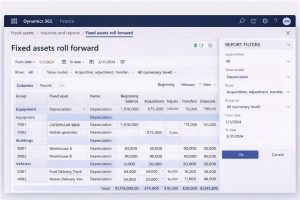
That is where inconsistent setup becomes expensive. D365’s Fixed asset valuations page shows current valuation by book and lets users drill back to the detailed transactions behind the summary. The Fixed assets roll forward report provides start and end balances, valuation movements, acquisitions, and disposals for period close, financial statements, and tax reporting. When the structure is standardized, those tools are powerful. When it is not, they become a front-row seat to your process debt.
What D365 Finance actually enables
D365 is not short on fixed asset mechanics. It supports acquisition, depreciation, acquisition adjustments, disposals, and reclassification/split scenarios. Fixed asset transactions can originate through Accounts payable, Procurement and sourcing, General ledger, Accounts receivable for disposal sale scenarios, and Inventory management when items are transferred into fixed assets. Reclassification is also a defined process: an asset is transferred to a new fixed asset group or assigned a new fixed asset number in the same group.
That matters because fixed assets do not live only in finance. They cross procurement, operations, tax, and reporting. Logan reality check: lots of asset records do not automatically equal insight. It just means you have more rows to argue about.
Why ESG and remote audits raise the bar
ESG does not magically turn fixed assets into a sustainability module, but it absolutely raises the standard for asset data discipline. In Microsoft Sustainability Manager, organizations can relate emissions activity data to an asset through custom dimensions, and asset-specific emissions methods rely on structured asset-related activity data. That means D365 Finance is often part of the foundation, even when the actual emissions calculations happen elsewhere. In practical terms: Finance should own the clean asset master, classifications, books, and lifecycle history; sustainability and facilities teams can layer additional operational data on top.
Remote audits raise the same issue from another angle. They reward drillable, system-based evidence, not heroic spreadsheet archaeology. If your fixed asset story still depends on “the file Susan keeps on the shared drive,” that is not audit readiness. That is folklore with version control problems.
Final thought
Fixed assets are usually framed as a reporting problem. They are really a design problem.
D365 Finance already has the control points: fixed asset groups, books, depreciation profiles, posting profiles, capitalization thresholds, reclassification processes, transaction detail, and roll-forward reporting. The difference is whether the organization treats fixed assets as a governed operating model or as a patchwork of local habits.
When those rules are standardized, fixed asset management gives you more than compliance. It gives you confidence, control, and fewer month-end conversations that begin with, “Well, that depends which spreadsheet you’re looking at.”