





Reviews and corrects ledger-to-subledger alignment in D365 by fixing posting configurations, inventory profiles, reconciliation logic, GL mapping, and critical reporting procedures.
Product Tracking Isn’t a Visibility Problem. It’s a Process Problem.
Posted on: March 5, 2026 | By: Ashley Xue | Microsoft Dynamics AX/365
Most organizations think they have a visibility problem.
Usually, they have a process problem wearing a visibility costume.
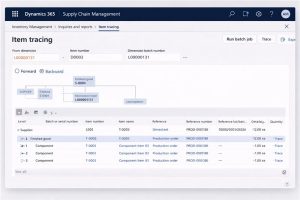
Products already leave a trail through receiving, warehouse work, production, and shipment. In Dynamics 365 Supply Chain Management, item tracing is based on historical inventory transactions plus a tracking dimension such as a batch, serial, or vendor batch number. From there, users can trace backward to the source and forward through production and sale. The catch is simple: the system can only trace what the business chose to capture consistently in the first place.
That is why the tracking conversation so often starts in the wrong place. Teams go hunting for a better report when the real issue was created earlier during item setup, warehouse design, and transaction execution.

Where product tracking actually breaks down
Tracking usually fails under pressure, not during a calm Tuesday afternoon. It shows up when a customer asks where a serialized unit went, when quality wants to know which batch was affected, or when an audit request lands with the emotional tone of a tax-season surprise.
In D365, that pressure gets exposed quickly because the setup matters. Storage dimension groups control how items are stored and taken from inventory, while tracking dimension groups determine which tracking dimensions—such as batch and serial—can be assigned to a product. Microsoft also recommends defining warehouse structure, policies, rules, and workflows early because those decisions affect configuration, testing, and reporting downstream. In other words, traceability is mostly decided before anyone clicks “run inquiry.”
Logan POV: if one site tracks by batch, another tracks by serial, and a third tracks by “ask Steve,” you do not have enterprise visibility. You have folklore.
What D365 Supply Chain Management actually enables
D365 gives organizations the building blocks for real product traceability. Microsoft defines three inventory dimension types: product, storage, and tracking. Storage and tracking can include site, warehouse, location, inventory status, license plate, batch number, and serial number, and companies can decide which storage and tracking dimensions are also tracked financially. That matters because good tracking is not just about knowing where inventory is. It is about knowing what happened to it operationally and, when needed, financially.
Warehouse execution can also reinforce discipline instead of relying on memory. Mobile device menu items drive warehouse work, and D365 lets teams configure confirmation steps for batch, serial, license plate, and location. Microsoft’s GS1 support goes further: one barcode scan can capture multiple data elements—such as batch and expiration date—which reduces scanning effort and improves accuracy. That is a very good trade: less typing, fewer mistakes, fewer warehouse ghost stories.
For manufacturers, the story goes deeper than a pallet move. D365’s Tracked components capability lets workers register batch or serial numbers for materials and components and associate them with the batch or serial numbers of the finished goods they produce. Managers can then use the item tracing report to investigate lineage more effectively. And on the quality side, quality associations can automatically generate quality orders tied to sales, purchasing, inbound shipment orders, and production processes. When those controls are designed well, a quality investigation becomes a workflow—not a scavenger hunt.
Why flexibility becomes fragmentation
D365 is flexible, and that is both its strength and its trap.
If every facility makes its own local tracking decisions, the system will faithfully reflect those differences. It just will not magically reconcile them into a clean enterprise history later. That is why many organizations end up with the same awkward situation: lots of data, low confidence.
This is also where spreadsheets start creeping in. Someone exports transactions. Someone else adds notes. A third person color-codes exceptions. By Friday, everyone has “the answer,” but not the same one.
Logan reality check: Excel is a great analysis tool. It is a terrible chain-of-custody strategy.
Tracking is not just a warehouse story
One reason product tracking gets messy is that companies treat it like a warehouse-only issue. It is not.
In newer warehouse-enabled scenarios, D365 uses warehouse transactions to record how inventory is stored and moved in the warehouse, while operations with financial impact still rely on inventory transactions. The Warehouse transactions page is designed to show the warehouse-relevant trail, while the Inventory transaction details page shows the physical, financial, and settlement aspects of an inventory transaction. That split is important. It means good traceability depends on understanding both the movement history and the posting history.
It also means setup decisions echo into finance. Microsoft’s inventory posting guidance shows that when serialized items are received, a purchase order line can be split into separate inventory transactions by serial number, and those records tie into voucher posting logic. So yes—product tracking absolutely becomes a finance conversation once the transaction hits the books.
Designing tracking around decisions, not transactions
The smartest product tracking designs start with one question:
What business decision are we trying to support?
If the answer is recalls, then speed of backward and forward trace matters most. If the answer is warranty validation, serial capture at shipment becomes critical. If the answer is regulatory compliance, then batch lineage, quality events, and retained documentation all matter more than a prettier dashboard.
Once that decision is clear, D365 can be configured to support it consistently. That is the point. Traceability should not depend on heroic memory or local habits. It should emerge naturally from the way work gets done.
Microsoft even notes that one design goal of the warehouse mobile picking flows is to minimize unnecessary scanning and keying by prepopulating or skipping fields where possible. That is a subtle but important idea: the best tracking environment is not the one with the most controls. It is the one where correct behavior is the easiest behavior.
Final thought
Product tracking is often framed as a visibility challenge.
It is really a process design challenge.
D365 Supply Chain Management already contains the mechanics for end-to-end traceability: tracking dimensions, warehouse confirmation logic, barcode-driven data capture, item tracing, production genealogy, and transaction history. The difference is whether the organization treats tracking as a governed operating model or as a patchwork of local practices.
When processes are standardized and governance is intentional, product tracking gives you more than visibility, it gives you control.