


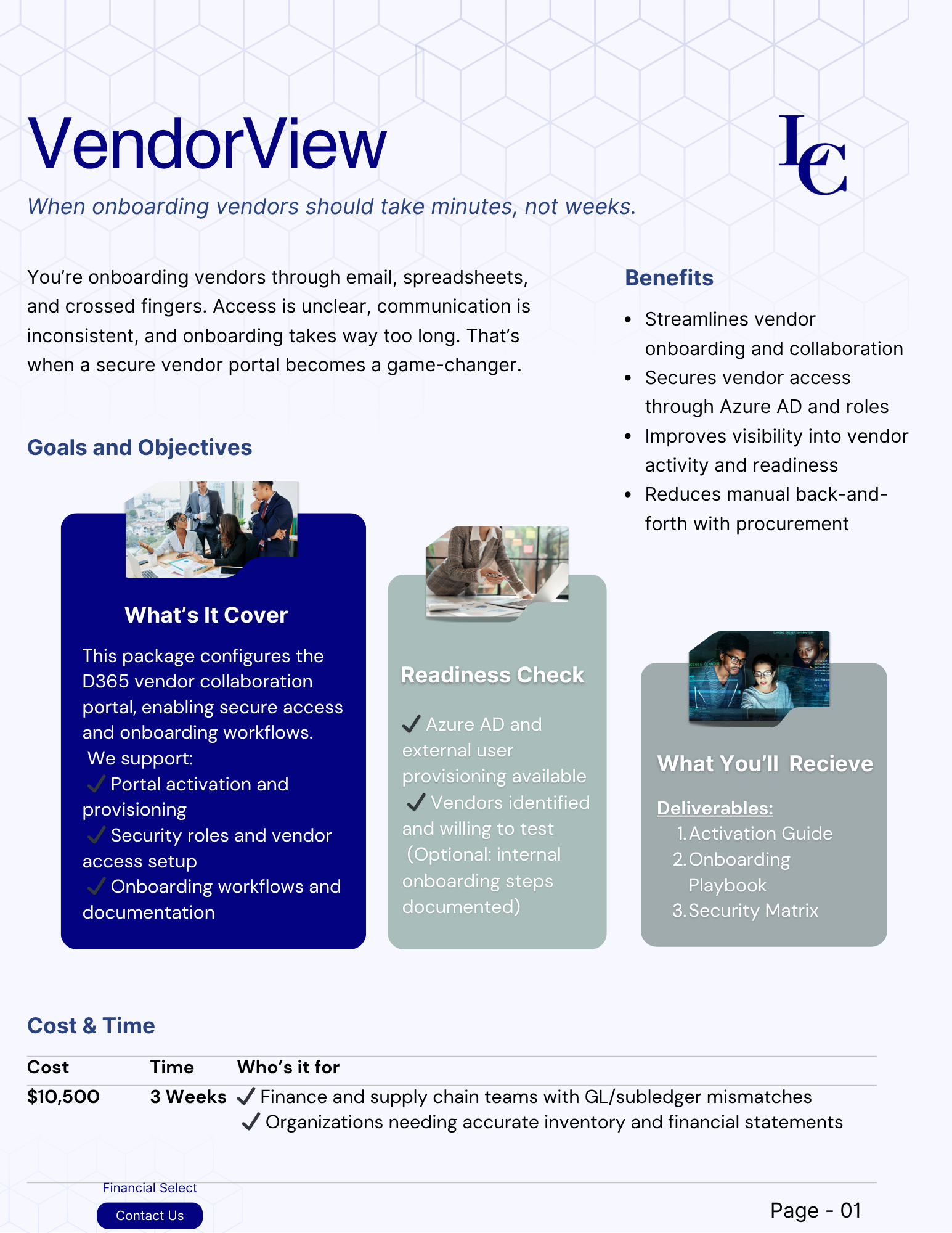


Reviews and corrects ledger-to-subledger alignment in D365 by fixing posting configurations, inventory profiles, reconciliation logic, GL mapping, and critical reporting procedures.
Making The Most Out of Financial Dimensions
Posted on: August 5, 2024 | By: Page Wildridge | Microsoft Dynamics Business Central
Microsoft Business Central utilizes financial dimensions to make processes more cohesive and efficient. Dimensions are used to group or filter your data in specific ways to make analysis easier. In this blog, we will cover four great ways to utilize financial dimensions to simplify your work in Business Central.

Job Codes
Instead of implementing an extensive job module, you can utilize financial dimensions to easily summarize job-related expenses and job-related revenues. The dimensions can be defined on all master and transactional records such as purchase orders, purchase invoices, sales orders, sales invoices, customer cards, and journal entries. This makes it easier to track all GL activity related to a specific job.
Then, you can filter out-of-the-box reports using the specific job. This allows you to view profitability, gross margin, and other key performance indicators on a specific job with just a few clicks.
Department Codes
In addition to using dimensions for specific jobs, you can set up your business’ departments as dimensions in Business Central. This enables you to track expenses by department. Further, Business Central also allows you to budget by dimension for a given year, month, and/or week. This makes it possible to compare actual expenses against budgeted amounts in one place.
Tags for Brokers
If you have clients that do not work directly with customers but instead interact with brokers, dimensions can be very helpful to track revenues by broker. If you assign a dimension code to the specific broker and define the dimension on sales transactions, you can use Business Central to generate reports specifically for the sales the broker has made.
Companies
Your business can utilize financial dimensions to keep track of company-wide finances as well. It is important to note that this functionality is only available for Multi-Entity Management (MEM) users. When you are using MEM, the dimension code corresponds to specific companies, so that every transaction is assigned to the company itself. This makes it easier to work with multiple companies at once within Business Central without having to configure the ERP for each company. All you need to do is tag each transaction with the corresponding company dimension.
Next Steps
Financial dimensions can be a powerful tool to make keeping track of company information much easier and quicker. If you are interested in learning more about the power of financial dimensions in Business Central, contact us today to speak to an expert. As proud Microsoft partners, Logan Consulting is here to assist you with getting the most out of your ERP.